
Technical Support & Resources
Visit our FAQ
Contact Us
Toll Free Phone (USA and Canada Only): (888) 526-5351
Direct Phone: (734) 975-3888
Product Categories
Product Type
BDNF (R129A, R130A mutant; mouse, recombinant)
Item No. 42754
Technical Information
- Brain-derived Neurotrophic Factor
Shipping & Storage Information
Recommended Products
Certificates of Analysis & Batch Specific Data
Provide batch numbers separated by commas to download or request available product inserts, QC sheets, certificates of analysis, data packs, and GC-MS data.

Visit Our Cancer Resource Center
Find Tools & Resources to Study the Hallmarks of Cancer
- Cancer cell signaling & regulation
- Cancer metabolism
- Tumor microenvironment
Product Description
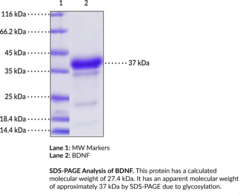
BDNF is a neurotrophin that is involved in synaptic plasticity and the growth, proliferation, and survival of neurons.1,2 It is synthesized as a precursor protein composed of a signal peptide, a prodomain, and mature BDNF sequence, which is secreted from neurons after cleavage of the proprotein.1 Incorporation of R129A and R130A mutations into Bdnf removes the dibasic amino acid motif that is required for processing of proBdnf to mature Bdnf.3 Bdnf is expressed in several brain regions to varying degrees with the highest levels in the hippocampus and cerebral cortex.4 BDNF homodimerizes and induces neurotropic signaling through tropomyosin-related kinase B (TrkB) and the p75 neurotrophin receptor (p75NTR).1,5 BDNF increases the proliferation of choriocarcinoma cells in vitro.5 It also induces long-term potentiation (LTP) in rat hippocampus.6 Knockout of Bdnf decreases coordination and balance and sensory neuronal survival in mice.7 Serum levels of BDNF are decreased in patients with depression or schizophrenia and brain expression of BDNF mRNA is decreased in patients with Alzheimer’s disease.2 Cayman’s BDNF (R129A, R140A mutant; mouse, recombinant) protein consists of 242 amino acids, has a calculated molecular weight of 27.4 kDa, and a predicted N-terminus of Ala19 after signal peptide cleavage. By SDS-PAGE, the apparent molecular mass of the protein is 37 kDa due to glycosylation.
WARNING This product is not for human or veterinary use.
References & Product Citations
1. NGF, BDNF, NT3, and NT4. Neurotrophic Factors. Handbook of Experimental Pharmacology 220, 3-15 (2014).
2. Effects of BDNF polymorphisms on brain function and behavior in health and disease. Brain Res. Bull. 86(5-6), 287-297 (2011).
3. HBpF-
4. Regional distribution of brain-
5. Inhibition of brain-
6. Brain-
7. Mice lacking brain-
Contact Info
Cayman Chemical1180 East Ellsworth RoadAnn Arbor, Michigan 48108 USAToll Free: (800) 364-9897(USA and Canada only)Fax: (734) 971-3640


