
Technical Support & Resources
Visit our FAQ
Contact Us
Toll Free Phone (USA and Canada Only): (888) 526-5351
Direct Phone: (734) 975-3888
Product Categories
Product Type
Application
Technical Information
- Fibroblast Growth Factor 7
- HBGF-7
- Heparin-binding Growth Factor 7
- Keratinocyte Growth Factor
Shipping & Storage Information
Recommended Products
Certificates of Analysis & Batch Specific Data
Provide batch numbers separated by commas to download or request available product inserts, QC sheets, certificates of analysis, data packs, and GC-MS data.

Visit Our Cancer Resource Center
Find Tools & Resources to Study the Hallmarks of Cancer
- Cancer cell signaling & regulation
- Cancer metabolism
- Tumor microenvironment
Product Description
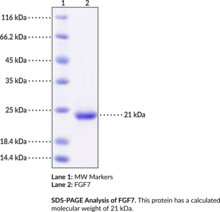
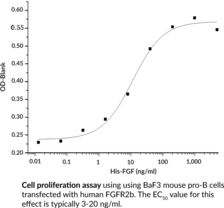
Fibroblast growth factor 7 (FGF7), also known as keratinocyte growth factor (KGF), is a member of the FGF7 subfamily.1,2 It is composed of an N-terminal signaling region, which is cleaved prior to secretion, a Cα backbone, a heparin-binding domain, and a receptor-binding domain.2,3 FGF7 is secreted by stromal fibroblasts and forms a quaternary complex with FGFR2b dimers, and to a lesser extent FGFR1b dimers, with heparan sulfate proteoglycans to induce ERK- or MAPK-induced proliferation in epithelial cells.4,3,1 It is also necessary for proper nephron and hippocampal development and post-radiation thymic regeneration in mice.4 Knockout of Fgf7 decreases cartilage erosion, osteophyte formation, bone density, and subchondral bone plate thickness in a mouse model of osteoarthritis induced by destabilization of the medial meniscus (DMM).5 Increased levels of FGF7 in cancer-associated fibroblasts are correlated with increased arterial and lymphatic metastasis, increased amount of residual tumor following surgery, and advanced cancer staging in patients with ovarian cancer.6 Cayman's FGF7 (human, recombinant) protein can be used for cell-based assays. This protein consists of 162 amino acids and has a calculated molecular weight of 21 kDa.
WARNING This product is not for human or veterinary use.
References & Product Citations
1. Initiation to end point: The multiple roles of fibroblast growth factors in neural development. Nat. Rev. Neurosci. 8(8), 583-596 (2007).
2. Structural basis for interaction of FGF-
3. Human KGF is FGF-
4. Structural biology of the FGF7 subfamily. Front. Genet. 10, 102 (2019).
5. Fibroblast growth factor 7 (FGF7) causes cartilage destruction, subchondral bone remodeling, and the premature growth plate closure in mice. Osteoarthritis Cartilage (2024).
6. Cancer-
Contact Info
Cayman Chemical1180 East Ellsworth RoadAnn Arbor, Michigan 48108 USAToll Free: (800) 364-9897(USA and Canada only)Fax: (734) 971-3640


