
Technical Support & Resources
Visit our FAQ
Contact Us
Toll Free Phone (USA and Canada Only): (888) 526-5351
Direct Phone: (734) 975-3888
Technical Information
- ANG-2
- ANGP2
- ANGPT2
Shipping & Storage Information
Recommended Products
Certificates of Analysis & Batch Specific Data
Provide batch numbers separated by commas to download or request available product inserts, QC sheets, certificates of analysis, data packs, and GC-MS data.

Visit Our Cancer Resource Center
Find Tools & Resources to Study the Hallmarks of Cancer
- Cancer cell signaling & regulation
- Cancer metabolism
- Tumor microenvironment
Product Description
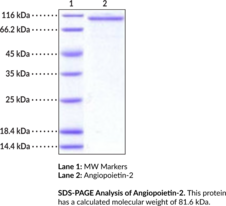
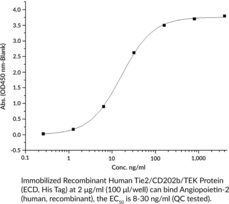
Angiopoietin-2 (ANG-2) is a member of the angiopoietin family of growth factors.1,2,3 It is composed of a superclustering domain, which mediates oligomerization, a coiled-coil domain, and a fibrinogen-like domain, which facilitates receptor binding. ANG-2 forms homomultimers, which are required for binding to its receptor tunica interna endothelial cell kinase 2 (Tie2), where it acts as an agonist or antagonist in a context-dependent manner. It is expressed in endothelium in tissues undergoing vascular remodeling in response to inflammation and hypoxia.2,3 ANG-2 plays a role in vascular remodeling and permeability, angiogenesis, lymphangiogenesis, and embryonic development. Serum levels of ANG-2 are increased in various diseases with increased vascular permeability, including sepsis, post-cardiac arrest syndrome, acute lung or kidney injury, and acute liver failure.4 Increased protein levels of ANG-2 are associated with lymph node metastasis and decreased survival in patients with colorectal cancer.5 Cayman’s Angiopoietin-2 (human, recombinant) protein can be used for binding assays. This protein is a disulfide-linked homodimer. The reduced monomer, composed of ANG-2 (amino acids 19-496) fused to human IgG1 Fc at its C-terminus, consists of 716 amino acids, has a calculated molecular weight of 81.6 kDa, and a predicted N-terminus of Tyr19 after signal peptide cleavage.
WARNING This product is not for human or veterinary use.
References & Product Citations
1. Signaling and functions of angiopoietin-
2. Targeting the ANGPT-
3. Role of angiopoietin-
4. Angiopoietin signaling in the vasculature. Exp. Cell Res. 319(9), 1271-1280 (2013).
5. Expressions and clinical significances of angiopoietin-
Contact Info
Cayman Chemical1180 East Ellsworth RoadAnn Arbor, Michigan 48108 USAToll Free: (800) 364-9897(USA and Canada only)Fax: (734) 971-3640


