
Technical Support & Resources
Visit our FAQ
Contact Us
Toll Free Phone (USA and Canada Only): (888) 526-5351
Direct Phone: (734) 975-3888
Product Categories
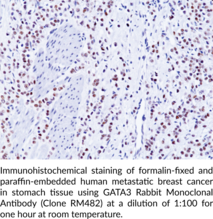
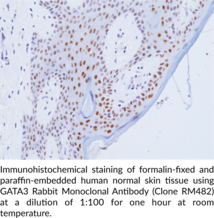
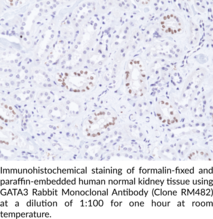
Technical Information
- GATA-binding Factor 3
- Trans-acting T cell-specific Transcription Factor GATA3
Shipping & Storage Information
Recommended Products
Certificates of Analysis & Batch Specific Data
Provide batch numbers separated by commas to download or request available product inserts, QC sheets, certificates of analysis, data packs, and GC-MS data.

Visit Our Cancer Resource Center
Find Tools & Resources to Study the Hallmarks of Cancer
- Cancer cell signaling & regulation
- Cancer metabolism
- Tumor microenvironment
Product Description
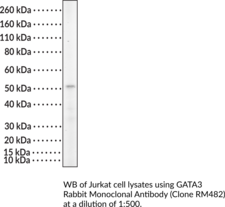
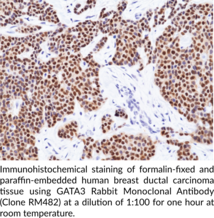
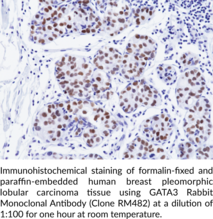
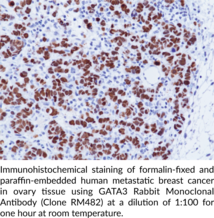
GATA3 is a zinc finger protein and transcription factor with roles in cell differentiation and organogenesis.1,2 It is composed of two N-terminal transactivating domains and two C-terminal zinc finger domains.3 GATA3 is expressed in hematopoietic cells, neurons, adipose tissue, mammary glands, renal tissue, skin, hair, parathyroid glands, and skeletal muscle.1 It functions as a primary transcription factor in germ cell specification programs and regulates the redistribution of T cell populations from Th2 to Th1 T helper cells. Mutations in GATA3 are associated with the autosomal dominant disorder hypoparathyroidism, sensorineural deafness, and renal dysplasia (HDR) syndrome, also known as Barakat syndrome.3 GATA3 downregulation is associated with poor prognosis and increased mortality in patients with urothelial malignancies.2 Cayman’s GATA3 Rabbit Monoclonal Antibody (Clone RM482) can be used for immunohistochemistry (IHC) and Western blot (WB) applications.
WARNING This product is not for human or veterinary use.
References & Product Citations
1. GATA3: Orchestrating cellular fate through differentiation and proliferation. Biochim. Biophys. Acta Mol. Cell Res. 1872(2), 119893 (2025).
2. Role of GATA3 in tumor diagnosis: A review. Pathol. Res. Pract. 226:153611, (2021).
3. A novel GATA3 frameshift mutation causes hypoparathyroidism, sensorineural deafness, and renal dysplasia syndrome. Mol. Genet. Metab. Rep. 38:101063, (2024).
Contact Info
Cayman Chemical1180 East Ellsworth RoadAnn Arbor, Michigan 48108 USAToll Free: (800) 364-9897(USA and Canada only)Fax: (734) 971-3640


