
Technical Support & Resources
Visit our FAQ
Contact Us
Toll Free Phone (USA and Canada Only): (888) 526-5351
Direct Phone: (734) 975-3888
Product Categories
Technical Information
- HVED
- Necl-5
- Nectin-like Protein 5
- TAGE4
Shipping & Storage Information
Recommended Products
Certificates of Analysis & Batch Specific Data
Provide batch numbers separated by commas to download or request available product inserts, QC sheets, certificates of analysis, data packs, and GC-MS data.
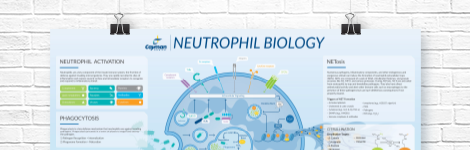
Neutrophil Biology Wall Poster
Explore how neutrophils shape the immune response in health and disease. This poster highlights neutrophil pathogen defense mechanisms, including phagocytosis, degranulation, and NETosis, as well as neutrophil roles in inflammation and NET-associated pathologies.
DOWNLOAD NOWProduct Description
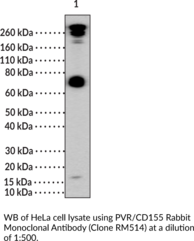
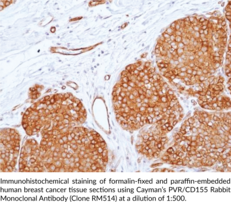
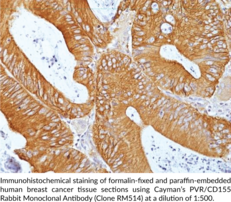
Poliovirus receptor (PVR), also known as CD155, is a member of the nectin-like family of adhesion molecules encoded by the Pvr gene in mice that regulates cell migration and proliferation and immune cell activation.1 It contains an N-terminal extracellular domain with three immunoglobulin-like (Ig-like) loops, C1-like and C2 domains that mediate dimerization, a transmembrane segment that acts as a ligand for receptors expressed by immune cells, and a C-terminal cytoplasmic tail that interacts with intracellular scaffold proteins.1,2 PVR is highly expressed by enterocytes and gastrointestinal lymphatic tissues.3 It localizes to the cell surface where it forms cis-homodimers that associate by trans-interactions with nectin-3 cis-homodimers expressed on adjacent cells, resulting in cell-cell adhesion.1 PVR internalization by endocytosis disrupts PDGFR and integrin αVβ3 signaling, inducing contact inhibition of cell movement and proliferation.1,2 PVR binds the co-stimulatory receptor CD226/DNAM-1, which is widely expressed by most immune cells, including T cells, B cells, natural killer (NK) cells, and monocytes, and the inhibitory receptors TIGIT and CD96, which are expressed by NK cells and T cells, inducing activation or inhibition of immune cells in a receptor-specific manner.1 It is also the receptor for poliovirus attachment and entry into cells. In cancer cells, PVR expression is upregulated by FGF stimulation or expression of the oncogene Ras and downregulated by the unfolded protein response.4 Pvr knockdown reduces tumor growth and the number of lung metastases in B16/F10 or LWT1 mouse xenograft models.5 Cayman’s PVR/CD155 Rabbit Monoclonal Antibody (Clone RM514) can be used for immunohistochemistry (IHC) and Western blot (WB) applications.
WARNING This product is not for human or veterinary use.
References & Product Citations
1. Targeting PVR (CD155) and its receptors in anti-
2. Nectins and nectin-
3. Recruitment of nectin-
4. UPR decreases CD226 ligand CD155 expression and sensitivity to NK cell-
5. CD155 loss enhances tumor suppression via combined host and tumor-
Contact Info
Cayman Chemical1180 East Ellsworth RoadAnn Arbor, Michigan 48108 USAToll Free: (800) 364-9897(USA and Canada only)Fax: (734) 971-3640


