
Technical Support & Resources
Visit our FAQ
Contact Us
Toll Free Phone (USA and Canada Only): (888) 526-5351
Direct Phone: (734) 975-3888
Product Categories
Application
Technical Information
Shipping & Storage Information
Recommended Products
Certificates of Analysis & Batch Specific Data
Provide batch numbers separated by commas to download or request available product inserts, QC sheets, certificates of analysis, data packs, and GC-MS data.
Product Description
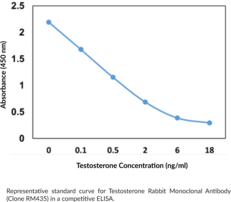
Testosterone is the prototypic and predominant circulating androgenic steroid.1,2 It plays a major role in the growth and function of many reproductive and non-reproductive tissues and organs including muscle, liver, and brain, directing the development of the male phenotype during embryogenesis at puberty.1 Testosterone is synthesized from pregnenolone by two main pathways, the Δ4 and Δ5 pathways. Both of these pathways involve the same three enzymes: the cytochrome P450 (CYP) isoform CYP17, 3β-hydroxysteroid dehydrogenase (3β-HSD), and 17β-HSD. The human CYP17 favors the Δ5 pathway, in which 17-hydroxypregnenolone is converted first to dehydroepiandrosterone (DHEA), then androstenedione, and finally testosterone. The Δ4 pathway in which 17-hydroxyprogesterone is converted to androstenedione is also important, but less favored in humans. While testosterone is the androgen responsible for biological activity in tissues such as muscle, in other tissues including gonads and skin, it is converted to 5α-DHT by the action of 5α-reductase. Cayman's Testosterone Rabbit Monoclonal Antibody (Clone RM435) can be used for ELISA.
WARNING This product is not for human or veterinary use.
References & Product Citations
1. Biochemical and physiological aspects of endogenous androgens. Handb. Exp. Pharmacol. 195, 25-64 (2010).
2. Analysis of androgens and their derivatives. Steroid Analysis 457-558 (2010).
Contact Info
Cayman Chemical1180 East Ellsworth RoadAnn Arbor, Michigan 48108 USAToll Free: (800) 364-9897(USA and Canada only)Fax: (734) 971-3640


