
Technical Support & Resources
Visit our FAQ
Contact Us
Toll Free Phone (USA and Canada Only): (888) 526-5351
Direct Phone: (734) 975-3888
Product Categories
Research Area
Application
Technical Information
- Adenosine 3',5'-cyclic mononucleotide
- Adenosine 3',5'-cyclic monophosphate
- cAMP
Shipping & Storage Information
Recommended Products
Certificates of Analysis & Batch Specific Data
Provide batch numbers separated by commas to download or request available product inserts, QC sheets, certificates of analysis, data packs, and GC-MS data.
Product Description
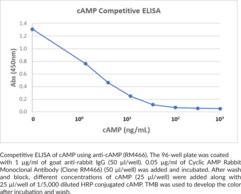
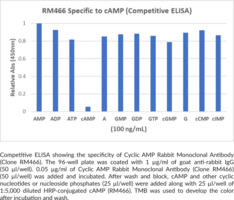
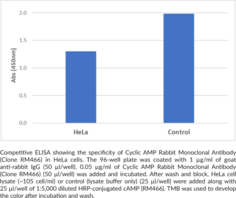
Cyclic AMP (cAMP) is a ubiquitous cellular second messenger and critical component of G protein-coupled receptor (GPCR) pathways that use Gαs or Gαi subunits for signaling.1 cAMP is synthesized by membrane-bound adenylate cyclase from ATP after the binding of ligands to Gαs-linked GPCRs. It activates various targets, including PKA, the guanine nucleotide exchange factor EPAC, and cyclic nucleotide-gated ion channels, that have roles in a wide variety of cellular processes from gene transcription to calcium signaling.1,2 cAMP synthesis is prevented by Gαi-linked GPCR activation, which inhibits adenylate cyclase, and its activity can be attenuated by phosphodiesterase-mediated hydrolysis to AMP.1 Therefore, the concentration of cAMP in a cell is a function of the ratio of synthesis from ATP by adenylate cyclase and its rate of breakdown to AMP by phosphodiesterases. Cayman’s Cyclic AMP Rabbit Monoclonal Antibody (Clone RM466) can be used for ELISA.
WARNING This product is not for human or veterinary use.
References & Product Citations
1. The cyclic AMP pathway. Cold Spring Harb. Perspect. Biol. 4(12), a011148 (2012).
2. Cyclic AMP signalling. J. Cell Sci. 114(Pt 11), 1971-1972 (2001).
Contact Info
Cayman Chemical1180 East Ellsworth RoadAnn Arbor, Michigan 48108 USAToll Free: (800) 364-9897(USA and Canada only)Fax: (734) 971-3640


