
Technical Support & Resources
Visit our FAQ
Contact Us
Toll Free Phone (USA and Canada Only): (888) 526-5351
Direct Phone: (734) 975-3888
Product Categories
Application
Technical Information
- ATG1
- Autophagy-related 1 Homolog
- Unc-51-like Autophagy Activating Kinase 1
Shipping & Storage Information
Recommended Products
Certificates of Analysis & Batch Specific Data
Provide batch numbers separated by commas to download or request available product inserts, QC sheets, certificates of analysis, data packs, and GC-MS data.
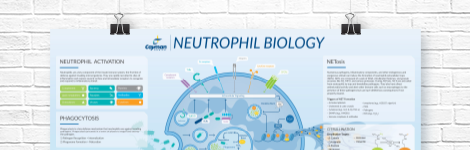
Neutrophil Biology Wall Poster
Explore how neutrophils shape the immune response in health and disease. This poster highlights neutrophil pathogen defense mechanisms, including phagocytosis, degranulation, and NETosis, as well as neutrophil roles in inflammation and NET-associated pathologies.
DOWNLOAD NOWProduct Description
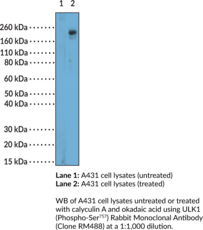
Unc-51-like autophagy activating kinase 1 (ULK1), also known as autophagy-related 1 homolog (ATG1), is a kinase involved in initiating autophagy.1,2 It is composed of an N-terminal kinase domain, a proline serine-rich domain, and two C-terminal microtubule-interacting and transporter (MIT) domains.2 ULK1 forms a complex with ATG12, ATG5, and ATG15L1 to sequester cargo in autophagosomes prior to transport to and fusion with lysosomes.1,3 It is activated when AMP-activated protein kinase (AMPK) phosphorylates Ser317 and Ser777 in response to low nutrient availability and deactivated when mTORC1 phosphorylates Ser757.4,5 ULK1 phosphorylates and deactivates STING in response to STING-induced increases in levels of cyclic dinucleotides.6 Cayman's ULK1 (Phospho-Ser757) Rabbit Monoclonal Antibody (Clone RM488) can be used for Western blot (WB).
WARNING This product is not for human or veterinary use.
References & Product Citations
1. An overview of autophagy: Morphology, mechanism, and regulation. Antioxid. Redox Signal. 20(3), 460-473 (2014).
2. Structure and function of the ULK1 complex in autophagy. Curr. Opin. Cell Biol. 39, 61-68 (2016).
3. Nutrient-
4. AMPK and mTOR regulate autophagy through direct phosphorylation of Ulk1. Nat. Cell Biol. 13(2), 132-141 (2011).
5. Design of small molecule autophagy modulators: A promising druggable strategy. J. Med. Chem. 61(11), 4656-4687 (2017).
6. Cyclic dinucleotides trigger ULK1 (ATG1) phosphorylation of STING to prevent sustained innate immune signaling. Cell 155(3), 688-698 (2013).
Contact Info
Cayman Chemical1180 East Ellsworth RoadAnn Arbor, Michigan 48108 USAToll Free: (800) 364-9897(USA and Canada only)Fax: (734) 971-3640


