
Technical Support & Resources
Visit our FAQ
Contact Us
Toll Free Phone (USA and Canada Only): (888) 526-5351
Direct Phone: (734) 975-3888
Product Categories
Technical Information
- p35
- Annexin I
- ANXA1
- Calpactin II
- Chromobindin-9
- Lipocortin I
Shipping & Storage Information
Recommended Products
Certificates of Analysis & Batch Specific Data
Provide batch numbers separated by commas to download or request available product inserts, QC sheets, certificates of analysis, data packs, and GC-MS data.

Visit Our Cancer Resource Center
Find Tools & Resources to Study the Hallmarks of Cancer
- Cancer cell signaling & regulation
- Cancer metabolism
- Tumor microenvironment
Product Description
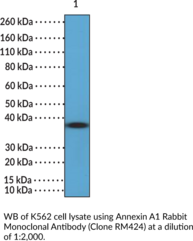
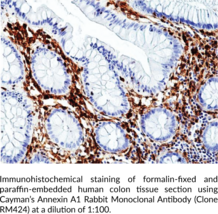
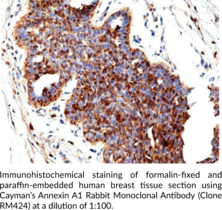
Annexin A1 is a member of the annexin superfamily with roles in eicosanoid generation, innate and adaptive immunity, and the resolution of inflammation.1,2,3,4 Under homeostatic conditions, annexin A1 is localized in the cytosol and expressed primarily in innate immune cells, including eosinophils, mast cells, macrophages, neutrophils, and monocytes, but is also expressed in lymphocytes.1,4 Annexin A1 interacts with phospholipase A2 (PLA2) to prevent eicosanoid synthesis and reduce neutrophil recruitment into inflammatory sites.5 It also induces neutrophil apoptosis and promotes efferocytosis. Differential expression of annexin A1 has been associated with cancer progression, metastasis, lymphatic invasion, and chemoresistance.3,2 Cayman’s Annexin A1 Rabbit Monoclonal Antibody (Clone RM424) can be used for immunohistochemistry (IHC) and Western blot (WB) applications.
WARNING This product is not for human or veterinary use.
References & Product Citations
1. Annexin-
2. Annexin A1 as a regulator of immune response in cancer. Cells 10(9), 2245 (2021).
3. Annexin A1: A bane or a boon in cancer? A systematic review. Molecules 25(16), 3700 (2020).
4. Annexin A1 and autoimmunity: From basic science to clinical applications. Int. J. Mol. Sci. 19(5), 1348 (2018).
5. Annexin A1 and the resolution of inflammation: Modulation of neutrophil recruitment, apoptosis, and clearance. J. Immunol. Res. 2016:8239258, (2016).
Contact Info
Cayman Chemical1180 East Ellsworth RoadAnn Arbor, Michigan 48108 USAToll Free: (800) 364-9897(USA and Canada only)Fax: (734) 971-3640


