
Technical Support & Resources
Visit our FAQ
Contact Us
Toll Free Phone (USA and Canada Only): (888) 526-5351
Direct Phone: (734) 975-3888
Product Categories
Application
Technical Information
- CAP4
- CASP-8
- Apoptosis Protease Mch-5
- FADD-homologous ICE/ced-3-like Protease
- FADD-like ICE
- FLICE
- ICE-like Apoptotic Protease 5
- MACH
- MORT-1-associated ced-3 Homolog
Shipping & Storage Information
Recommended Products
Certificates of Analysis & Batch Specific Data
Provide batch numbers separated by commas to download or request available product inserts, QC sheets, certificates of analysis, data packs, and GC-MS data.

Visit Our Cancer Resource Center
Find Tools & Resources to Study the Hallmarks of Cancer
- Cancer cell signaling & regulation
- Cancer metabolism
- Tumor microenvironment
Product Description
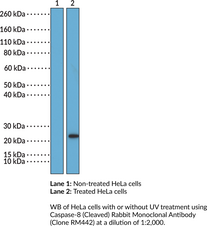
Caspase-8 is an initiator caspase with roles in cell death, including induction of apoptosis and pyroptosis and inhibition of necroptosis.1 It is widely expressed during development and adulthood with high levels of expression in the heart and limb buds, as well as other tissues, in development and in leukocytes in adulthood.2 It localizes to the cytosol and can be found in the lamella of migrating cells.3 Caspase-8 is produced as an inactive proenzyme containing a prodomain, which is composed of two N-terminal death-effector domains (DEDs), and two C-terminal catalytic subunits: p18 and p10.4,1 Activation of the proenzyme occurs when it binds to the death-inducing signaling complex (DISC), which is composed of CD95, a Fas-associated death domain (FADD) protein, and cellular FLICE-like inhibitory protein (c-FLIP). Upon DISC binding, procaspase-8 is cleaved to release the p10 subunit, then the p18 subunit. Together, two of each subunit form an activated and stabilized heterotetramer, which cleaves other procaspases, including procaspase-3 and procaspase-7, to initiate the extrinsic apoptosis pathway. Caspase-8 also has a role in the innate immune response via its activation by toll-like receptor 4 (TLR4) signaling and its initiation of the pyroptosis pathway through the NOD-like receptor protein 3 (NLRP3) inflammasome.1 Mutations in CASP8, the gene encoding caspase-8, or dysfunctional caspase-8 activity are associated with a variety of conditions, including autoimmune disorders, immunodeficiencies, and an increased risk of cancer. Cayman’s Caspase-8 (Cleaved) Rabbit Monoclonal Antibody (Clone RM442) be used for Western blot (WB).
WARNING This product is not for human or veterinary use.
References & Product Citations
1. The role of caspase-
2. Caspase-
3. Caspase-
4. Mechanisms of procaspase-
Contact Info
Cayman Chemical1180 East Ellsworth RoadAnn Arbor, Michigan 48108 USAToll Free: (800) 364-9897(USA and Canada only)Fax: (734) 971-3640


