Technical Support & Resources
Visit our FAQ
Contact Us
Toll Free Phone (USA and Canada Only): (888) 526-5351
Direct Phone: (734) 975-3888
Product Categories
Technical Information
- CA9
- Carbonate Dehydratase IX
- Carbonic Anhydrase 9
- Carbonic Anhydrase IX
Shipping & Storage Information
Recommended Products
Certificates of Analysis & Batch Specific Data
Provide batch numbers separated by commas to download or request available product inserts, QC sheets, certificates of analysis, data packs, and GC-MS data.

Visit Our Cancer Resource Center
Find Tools & Resources to Study the Hallmarks of Cancer
- Cancer cell signaling & regulation
- Cancer metabolism
- Tumor microenvironment
Product Description
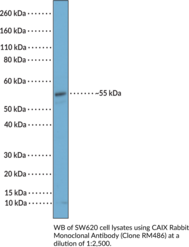
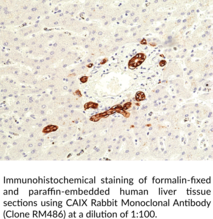
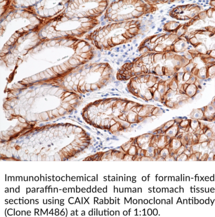
Carbonic anhydrase IX (CAIX) is a transmembrane carbonic anhydrase and a member of the carbonic anhydrase family.1,2 It is composed of an N-terminal proteoglycan-like domain, a catalytic domain, a transmembrane region, and a C-terminal cytosolic tail.3 CAIX is expressed in the epithelia of the gastrointestinal tract where it catalyzes the reversible zinc-dependent hydrolysis of carbon dioxide (CO2) and maintains intracellular pH homeostasis.1,2 The levels of CAIX are increased in chronically hypoxic tumors, which contributes to the acidification of the extracellular matrix (ECM) by decreasing elevated intracellular CO2 levels produced from increased metabolism.2 CAIX inhibition decreases metastasis and increases hypoxic stress in mouse breast cancer xenograft models.4 High tumor levels of CAIX are correlated with distant metastasis and poor survival in patients with breast cancer.5 Cayman's CAIX Rabbit Monoclonal Antibody (Clone RM486) can be used for immunohistochemistry (IHC) and Western blot (WB) applications.
WARNING This product is not for human or veterinary use.
References & Product Citations
1. Carbonic anhydrases as targets for medicinal chemistry. Bioorg. Med. Chem. 15(13), 4336-4350 (2007).
2. Carbonic anhydrase IX and acid transport in cancer. Br. J. Cancer. 122(2), 157-167 (2020).
3. Carbonic anhydrase inhibitors: Inhibition of the tumor-
4. Antimetastatic effect of sulfamate carbonic anhydrase IX inhibitors in breast carcinoma xenografts. J. Med. Chem. 55(11), 5591-5600 (2012).
5. Targeting tumor hypoxia: suppression of breast tumor growth and metastasis by novel carbonic anhydrase IX inhibitors. Cancer Res. 71(9), 3364-3376 (2011).
Contact Info
Cayman Chemical1180 East Ellsworth RoadAnn Arbor, Michigan 48108 USAToll Free: (800) 364-9897(USA and Canada only)Fax: (734) 971-3640