
Technical Support & Resources
Visit our FAQ
Contact Us
Toll Free Phone (USA and Canada Only): (888) 526-5351
Direct Phone: (734) 975-3888
Product Categories
Application
Technical Information
- Cytotoxic Granule-associated RNA-Binding Protein TIA-1
- Nucleolysin TIA-1 Isoform p40
- T-cell-restricted Intracellular Antigen-1
Shipping & Storage Information
Recommended Products
Certificates of Analysis & Batch Specific Data
Provide batch numbers separated by commas to download or request available product inserts, QC sheets, certificates of analysis, data packs, and GC-MS data.
Product Description
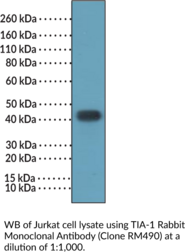
T-cell-restricted intracellular antigen-1 (TIA-1) is an RNA-binding protein that plays a role in pre-mRNA splicing, RNA metabolism, and stress granule formation.1 It is composed of three RNA recognition motifs (RRMs) and a C-terminal glutamine-rich auxiliary region, where RRM3 mediates nuclear export and RRM2 and part of the C-terminal region mediate nuclear import.2,3 TIA-1 exists as two isoforms, is ubiquitously expressed, and localizes to the cytoplasm and nucleus. It is involved in the regulation of diverse biological processes, including transcription, translation, stress response, apoptosis, and autophagy, among others.1 Mutations in TIA-1 are associated with Welander distal myopathy, amyotrophic lateral sclerosis (ALS), and ALS with frontotemporal dementia (FTD).4,5 Cayman’s TIA-1 Rabbit Monoclonal Antibody (Clone RM490) can be used for Western blot (WB).
WARNING This product is not for human or veterinary use.
References & Product Citations
1. The multifunctional faces of T-
2. Two isoforms of the T-
3. Identification of the sequence determinants mediating the nucleo-
4. Welander distal myopathy is caused by a mutation in the RNA-
5. TIA1 mutations in amyotrophic lateral sclerosis and frontotemporal dementia promote phase separation and alter stress granule dynamics. Neuron. 94(4), 808-816 (2017).
Contact Info
Cayman Chemical1180 East Ellsworth RoadAnn Arbor, Michigan 48108 USAToll Free: (800) 364-9897(USA and Canada only)Fax: (734) 971-3640


