
Technical Support & Resources
Visit our FAQ
Contact Us
Toll Free Phone (USA and Canada Only): (888) 526-5351
Direct Phone: (734) 975-3888
Product Categories
Technical Information
- LAMP-4
- Lysosome-associated Membrane Protein 4
- Macrosialin; Gp110
Shipping & Storage Information
Recommended Products
Certificates of Analysis & Batch Specific Data
Provide batch numbers separated by commas to download or request available product inserts, QC sheets, certificates of analysis, data packs, and GC-MS data.

Visit Our Cancer Resource Center
Find Tools & Resources to Study the Hallmarks of Cancer
- Cancer cell signaling & regulation
- Cancer metabolism
- Tumor microenvironment
Product Description
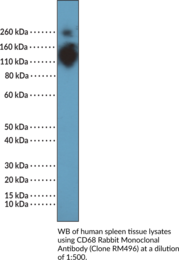
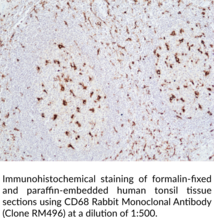
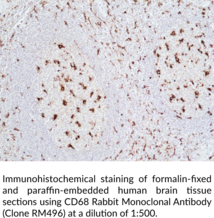
CD68, also known as macrosialin, is a lysosome-associated membrane protein (LAMP).1 It is composed of an N-terminal cleavable signal peptide, a mucin-like domain, which is heavily glycosylated, a proline hinge region, a LAMP-like domain, a transmembrane domain, and a C-terminal cytoplasmic tail.2 CD68 localizes to endosomal and lysosomal membranes but can also be localized in the plasma membrane.1 It is expressed primarily in mononuclear phagocytes, such as macrophages, microglia, osteoclasts, and myeloid dendritic cells, but can also be expressed to a lesser extent in CD19+ B cells and CD4+ T cells.2 CD68 overexpression in tumor cells is associated with immune evasion through the prevention of immune cell contact. It has been used as a non-specific cell surface marker for macrophages and tumor-associated macrophages (TAMs).1,3,2 Cd68+ macrophages levels are increased in mouse brain in a model of Gaucher's disease, a condition characterized by a lack of the glycolipid-metabolizing enzyme glucosylceramidase.4 High tumor levels of CD68 are correlated with poor prognosis in patients with glioblastoma multiforme (GBM) and thymoma.5 Cayman's CD68 Rabbit Monoclonal Antibody (Clone RM496) can be used for immunohistochemistry (IHC) and Western blot (WB) applications.
WARNING This product is not for human or veterinary use.
References & Product Citations
1. LAMPs: Shedding light on cancer biology. Semin. Oncol. 44(4), 239-253 (2017).
2. CD68/macrosialin: Not just a histochemical marker. Lab. Invest. 97(1), 4-13 (2017).
3. Perilipin 1 deficiency in whole body or bone marrow-
4. CNS-
5. Role of CD68 in tumor immunity and prognosis prediction in pan-
Contact Info
Cayman Chemical1180 East Ellsworth RoadAnn Arbor, Michigan 48108 USAToll Free: (800) 364-9897(USA and Canada only)Fax: (734) 971-3640


