
Technical Support & Resources
Visit our FAQ
Contact Us
Toll Free Phone (USA and Canada Only): (888) 526-5351
Direct Phone: (734) 975-3888
Product Categories



Technical Information
- B7-H5
- PD-1H
- Platelet Receptor Gi24
- Programmed Death-1 Homolog
- SISP1
- Stress-induced Secreted Protein-1
- V-domain Ig Suppressor of T cell Activation
- V-set Immunoregulatory Receptor
- VSIR
- V-type Immunoglobulin Domain-containing Suppressor of T cell Activation
Shipping & Storage Information
Recommended Products
Certificates of Analysis & Batch Specific Data
Provide batch numbers separated by commas to download or request available product inserts, QC sheets, certificates of analysis, data packs, and GC-MS data.

Visit Our Cancer Resource Center
Find Tools & Resources to Study the Hallmarks of Cancer
- Cancer cell signaling & regulation
- Cancer metabolism
- Tumor microenvironment
Product Description
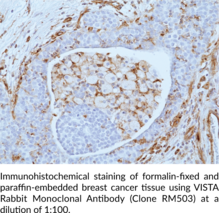
V-type immunoglobulin domain-containing suppressor of T cell activation (VISTA) is a type I transmembrane protein and negative immune checkpoint regulator.1,2,3,4 It is composed of an N-terminal immunoglobulin (Ig) V domain, a stalk domain, a transmembrane domain, and a cytoplasmic domain.2 VISTA is primarily expressed in myeloid lineage hematopoietic cells, as well as the spleen, placenta, and other tissues with infiltrating leukocytes.3,4,5 It is involved in immunosuppression of T cell activation and acts as a ligand and receptor.1,2,3,4 Increased protein levels of VISTA in tumor-infiltrating immune cells are associated with increased relapse-free survival in patients with estrogen receptor-negative, progesterone receptor-negative, triple-negative, HER2-positive, or basal-like breast cancer.6 Protein levels of VISTA are also increased in peripheral blood mononuclear cells (PBMCs) isolated from patients with myasthenia gravis.7 Cayman’s VISTA Rabbit Monoclonal Antibody (Clone RM503) can be used for immunohistochemistry (IHC) and Western blot (WB) applications.
WARNING This product is not for human or veterinary use.
References & Product Citations
1. VISTA: A novel immunotherapy target for normalizing innate and adaptive immunity. Semin. Immunol. 42, 101308 (2019).
2. Immunoregulatory functions of VISTA. Immunol. Rev. 276(1), 66-79 (2017).
3. New checkpoints in cancer immunotherapy. Immunol. Rev. 276(1), 52-65 (2017).
4. The expression and immunoregulation of immune checkpoint molecule VISTA in autoimmune diseases and cancers. Cytokine Growth Factor Rev. 52, 1-14 (2020).
5. VISTA is an immune checkpoint molecule for human T cells. Cancer Res. 74(7), 1924-1932 (2014).
6. Expression of the immune checkpoint VISTA in breast cancer. Cancer Immunol. Immunother. 69(8), 1437-1446 (2020).
7. Expression and correlation analysis of VISTA in peripheral blood mononuclear cells of myasthenia gravis patients. Int. Immunopharmacol. 148:114096, (2025).
Contact Info
Cayman Chemical1180 East Ellsworth RoadAnn Arbor, Michigan 48108 USAToll Free: (800) 364-9897(USA and Canada only)Fax: (734) 971-3640


