
Technical Support & Resources
Visit our FAQ
Contact Us
Toll Free Phone (USA and Canada Only): (888) 526-5351
Direct Phone: (734) 975-3888
Product Categories
Technical Information
Shipping & Storage Information
Recommended Products
Certificates of Analysis & Batch Specific Data
Provide batch numbers separated by commas to download or request available product inserts, QC sheets, certificates of analysis, data packs, and GC-MS data.

Visit Our Cancer Resource Center
Find Tools & Resources to Study the Hallmarks of Cancer
- Cancer cell signaling & regulation
- Cancer metabolism
- Tumor microenvironment
Product Description
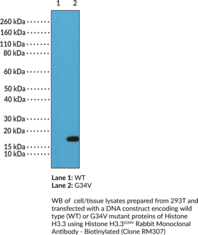
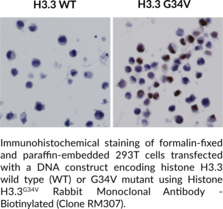
Histone H3 is a nuclear protein and component of the nucleosome core, a basic unit of chromatin, that is essential for organizing genomic DNA in eukaryotic nuclei.1 It is a globular protein that contains an unstructured N-terminal tail that extends outside of the nucleosome core and is subject to various post-translational modifications (PTMs). Metazoans have three histone variants: canonical histone H3.1, DNA replication-independent histone H3.3, and the centromeric variant CENP-A.2 Histone H3.3 is incorporated into chromatin in a DNA replication-independent manner at sites of active transcription.2,3,4 A missense mutation replacing guanine with adenine in H3F3A, the gene encoding histone H3.3, leads to a glycine-to-valine substitution, histone H3.3G34V, which is associated with glioblastoma multiforme in children and young adults.5 Cayman's Histone H3.3G34V Rabbit Monoclonal Antibody (Clone RM307) - Biotinylated can be used for ELISA, immunohistochemistry (IHC), and Western blot (WB) applications.
WARNING This product is not for human or veterinary use.
References & Product Citations
1. Writing, erasing and reading histone lysine methylations. Exp. Mol. Med. 49(4), e324 (2017).
2. New functions for an old variant: No substitute for histone H3.3. Curr. Opin. Genet. Dev. 20(2), 110-117 (2010).
3. Histone H3.3 mutations drive pediatric glioblastoma through upregulation of MYCN. Cancer Discov. 3(5), 512-519 (2013).
4. Histone H3.1 and H3.3 complexes mediate nucleosome assembly pathways dependent or independent of DNA synthesis. Cell 116(1), 51-61 (2004).
5. Driver mutations in histone H3.3 and chromatin remodelling genes in paediatric glioblastoma. Nature 482(7384), 226-231 (2012).
Contact Info
Cayman Chemical1180 East Ellsworth RoadAnn Arbor, Michigan 48108 USAToll Free: (800) 364-9897(USA and Canada only)Fax: (734) 971-3640


