
Technical Support & Resources
Visit our FAQ
Contact Us
Toll Free Phone (USA and Canada Only): (888) 526-5351
Direct Phone: (734) 975-3888
Technical Information
- CD306
- Leukocyte-associated Immunoglobulin-like Receptor 2
Shipping & Storage Information
Recommended Products
Certificates of Analysis & Batch Specific Data
Provide batch numbers separated by commas to download or request available product inserts, QC sheets, certificates of analysis, data packs, and GC-MS data.
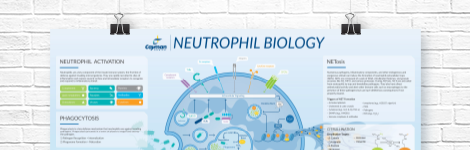
Neutrophil Biology Wall Poster
Explore how neutrophils shape the immune response in health and disease. This poster highlights neutrophil pathogen defense mechanisms, including phagocytosis, degranulation, and NETosis, as well as neutrophil roles in inflammation and NET-associated pathologies.
DOWNLOAD NOWProduct Description
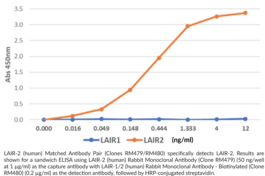
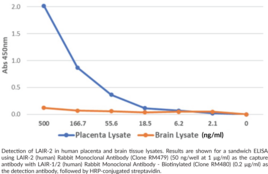
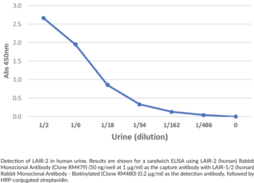
Capture Antibody: LAIR-2 (human) Rabbit Monoclonal Antibody (Clone RM479)
Detection Antibody: LAIR-1/2 (human) Rabbit Monoclonal Antibody - Biotinylated (Clone RM480)
Leukocyte-associated immunoglobulin-like receptor 2 (LAIR-2) is a soluble homolog of the membrane-bound inhibitory immune receptor LAIR-1.1 LAIR-2, which is composed of a single immunoglobulin-like domain, binds to collagen and inhibits the LAIR-1-collagen interaction and subsequent activation of immunocytes.1,2 It is produced by human peripheral blood mononuclear cells (PBMCs), monocytic and T cell lines, and activated CD4+ T cells.2,3 LAIR-2 fused to the Fc region of human IgG1 inhibits collagen-induced platelet aggregation, adhesion of platelets to collagen-coated coverslips, and binding of collagen to von Willebrand factor (VWF) and glycoprotein VI (GpVI).4 Elevated levels of LAIR-2 have been found in the urine of pregnant women, the synovial fluid of patients with rheumatoid arthritis, and sera from patients with autoimmune thyroid diseases.2,1 Cayman’s LAIR-2 (human) Matched Antibody Pair (Clones RM479/RM480) contains LAIR-2 (human) Rabbit Monoclonal Antibody (Clone RM479) as a capture antibody and LAIR-1 and LAIR-2 (human) Rabbit Monoclonal Antibody – Biotinylated (Clone RM480) as a detection antibody. This antibody pair can be used for sandwich ELISAs or other sandwich assays for the specific detection of LAIR-2 in human samples.
WARNING This product is not for human or veterinary use.
References & Product Citations
1. Serum LAIR-
2. The soluble leukocyte-
3. Enhanced secretion of leukocyte-
4. Efficient inhibition of collagen-
Contact Info
Cayman Chemical1180 East Ellsworth RoadAnn Arbor, Michigan 48108 USAToll Free: (800) 364-9897(USA and Canada only)Fax: (734) 971-3640


