
Technical Support & Resources
Visit our FAQ
Contact Us
Toll Free Phone (USA and Canada Only): (888) 526-5351
Direct Phone: (734) 975-3888
Product Categories
Product Type
Technical Information
- Axonal Glycoprotein TAG-1
- Axonin-1
- CNTN2
- TAG-1
- TAX-1
- Transient Axonal Glycoprotein 1
Shipping & Storage Information
Recommended Products
Certificates of Analysis & Batch Specific Data
Provide batch numbers separated by commas to download or request available product inserts, QC sheets, certificates of analysis, data packs, and GC-MS data.
Product Description
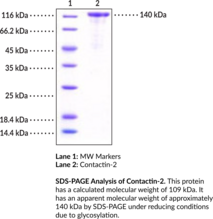
Contactin-2 is a neural cell adhesion molecule and member of the immunoglobulin (Ig) superfamily.1 It is composed of six Ig-like repeats, four fibronectin type III-like domains, and a hydrophobic C-terminal sequence that contains a glycosylphosphatidylinositol (GPI) anchor site. Contactin-2 localizes to the cell surface but also exists as a soluble form, which is produced via proteolytic cleavage by β-secretase 1 (BACE1).2 It is transiently expressed in neurons during embryonic development and in the brain and spinal cord in adult tissues.1,3 It is involved in axonal growth, guidance, and fasciculation and myelinated fiber formation and maintenance.1 Contactin-2 interacts with several partners, notably contactin-associated protein-like 2 (CASPR2) and juxtaparanodal potassium channels. Brain levels of contactin-2 are decreased in patients with Alzheimer’s disease.2 A frameshift mutation in the gene encoding contactin-2, CNTN2, is associated with epilepsy.4 Cayman’s Contactin-2 (human, recombinant) protein consists of 993 amino acids, has a calculated molecular weight of 109 kDa, and a predicted N-terminus of Ser31 after signal peptide cleavage. By SDS-PAGE, under reducing conditions, the apparent molecular mass of the protein is 140 kDa due to glycosylation.
WARNING This product is not for human or veterinary use.
References & Product Citations
1. Contactin-
2. BACE1 activity regulates cell surface contactin-
3. Human NB-
4. Case report: A case of epileptic disorder associated with a novel CNTN2 frameshift variant in homozygosity due to maternal uniparental disomy. Front. Genet. 12, 743833 (2021).
Contact Info
Cayman Chemical1180 East Ellsworth RoadAnn Arbor, Michigan 48108 USAToll Free: (800) 364-9897(USA and Canada only)Fax: (734) 971-3640


