
Technical Support & Resources
Visit our FAQ
Contact Us
Toll Free Phone (USA and Canada Only): (888) 526-5351
Direct Phone: (734) 975-3888
Product Categories
Product Type
Technical Information
- BIG-1
- Brain-derived Immunoglobulin Superfamily Protein 1
- CNTN3
- PANG
- PCS
- Plasmacytoma-associated Neuronal Glycoprotein
Shipping & Storage Information
Recommended Products
Certificates of Analysis & Batch Specific Data
Provide batch numbers separated by commas to download or request available product inserts, QC sheets, certificates of analysis, data packs, and GC-MS data.

Visit Our Cancer Resource Center
Find Tools & Resources to Study the Hallmarks of Cancer
- Cancer cell signaling & regulation
- Cancer metabolism
- Tumor microenvironment
Product Description
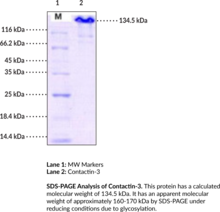
Contactin-3 is a neural cell adhesion molecule and member of the immunoglobulin (Ig) superfamily.1 It is composed of six Ig-like repeats, four fibronectin type III-like domains, and a hydrophobic C-terminal sequence that contains a glycosylphosphatidylinositol (GPI) anchor site. Contactin-3 is primarily expressed in the frontal lobe, occipital lobe, cerebellum, and amygdala in the brain where it interacts with amyloid precursor protein (APP), amyloid-β precursor-like protein 1 (APLP-1), and protein tyrosine phosphatase γ (PTPγ).2,3 Expression of CNTN3, the gene encoding contactin-3, is decreased in cortical tubers isolated from patients with tuberous sclerosis complex (TSC), a condition characterized by increased incidence of epilepsy and intellectual impairment.4 Low expression levels of CNTN3 are associated with decreased overall survival and poor prognosis in patients with glioblastoma multiforme.5 Cayman's Contactin-3 (human, recombinant) protein is a disulfide-linked homodimer. This protein is a disulfide-linked homodimer. The reduced monomer, composed of contactin-3 (amino acids 20-1,002) fused to IgG1 Fc at its C-terminus, consists of 1,221 amino acids, has a calculated molecular weight of 134.5 kDa, and a predicted N-terminus of Gly20 after signal peptide cleavage. By SDS-PAGE, under reducing conditions, the apparent molecular mass of the protein is 160-170 kDa due to glycosylation.
WARNING This product is not for human or veterinary use.
References & Product Citations
1. Contactins: Emerging key roles in the development and function of the nervous system. Cell Adh. Migr. 3(1), 64-70 (2009).
2. Human NB-
3. Structural basis for interactions between contactin family members and protein-
4. Down-
5. Prognostic significance of contactin 3 expression and associated genes in glioblastoma multiforme. Oncol. Lett. 18(2), 1863-1871 (2019).
Contact Info
Cayman Chemical1180 East Ellsworth RoadAnn Arbor, Michigan 48108 USAToll Free: (800) 364-9897(USA and Canada only)Fax: (734) 971-3640


