
Technical Support & Resources
Visit our FAQ
Contact Us
Toll Free Phone (USA and Canada Only): (888) 526-5351
Direct Phone: (734) 975-3888
Contactin-4 Long Isoform (human, recombinant)
Item No. 43688
Technical Information
- BIG-2
- Brain-derived Immunoglobulin Superfamily Protein 2
- CNTN4
Shipping & Storage Information
Recommended Products
Certificates of Analysis & Batch Specific Data
Provide batch numbers separated by commas to download or request available product inserts, QC sheets, certificates of analysis, data packs, and GC-MS data.
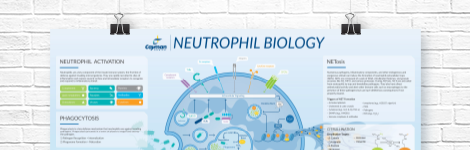
Neutrophil Biology Wall Poster
Explore how neutrophils shape the immune response in health and disease. This poster highlights neutrophil pathogen defense mechanisms, including phagocytosis, degranulation, and NETosis, as well as neutrophil roles in inflammation and NET-associated pathologies.
DOWNLOAD NOWProduct Description
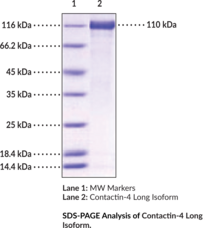
Contactin-4 is a neural cell adhesion molecule and member of the immunoglobulin (Ig) superfamily.1 It is composed of six Ig-like repeats, four fibronectin type III-like domains, and a hydrophobic C-terminal sequence that contains a glycosylphosphatidylinositol (GPI) anchor site. Contactin-4 is ubiquitously expressed in the brain with the highest levels in the cerebellum but is also expressed in leukocytes, testis, spinal cord, and thyroid.2 It is involved in neurodevelopment, arborization, synaptic plasticity, and learning and memory and interacts with amyloid precursor protein (APP), amyloid-β precursor-like protein 1 (APLP-1), and protein tyrosine phosphatase γ (PTPγ).1,3,4 Disruption of CNTN4, the gene encoding contactin-4, is associated with developmental delay and dysmorphic features.5 Cayman’s Contactin-4 Long Isoform (human, recombinant) protein consists of 993 amino acids, has a calculated molecular weight of 110 kDa, and a predicted N-terminus of Asp19 after signal peptide cleavage. By SDS-PAGE, under reducing conditions, the apparent molecular mass of the protein is approximately 120-130 kDa.
WARNING This product is not for human or veterinary use.
References & Product Citations
1. A current view on contactin-
2. Human NB-
3. Contactin-
4. Cntn4, a risk gene for neuropsychiatric disorders, modulates hippocampal synaptic plasticity and behavior. Transl. Psychiatry. 11(1), 106 (2021).
5. Disruption of Contactin 4 (CNTN4) results in developmental delay and other features of 3p deletion syndrome. Am. J. Hum. Genet. 74(6), 1286-1293 (2004).
Contact Info
Cayman Chemical1180 East Ellsworth RoadAnn Arbor, Michigan 48108 USAToll Free: (800) 364-9897(USA and Canada only)Fax: (734) 971-3640


