
Technical Support & Resources
Visit our FAQ
Contact Us
Toll Free Phone (USA and Canada Only): (888) 526-5351
Direct Phone: (734) 975-3888
Product Categories
Technical Information
- CASP-7
- Apoptotic Protease Mch-3
- CMH-1
- ICE-like Apoptotic Protease 3
- ICE-LAP3
Shipping & Storage Information
Recommended Products
Certificates of Analysis & Batch Specific Data
Provide batch numbers separated by commas to download or request available product inserts, QC sheets, certificates of analysis, data packs, and GC-MS data.
Lipid Resource Center
Discover Products & Resources for Lipid Research
- High-purity lipid standards
- Lipid roles in biology
- Lipids in health & disease
- Lipids for pharmaceutical development
- Protocols, advice, & resources
Product Description
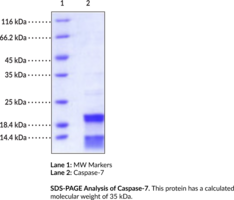
Caspase-7 is a cysteinyl aspartic protease and a member of the caspase family of proteases.1 It is expressed as a proprotein that upon pro-apoptotic signaling is cleaved into two subunits, p20 and p11, which form an active homodimer that recognizes and cleaves proteins containing the amino acid sequence DEVD.1,2 Caspase-7 is ubiquitously expressed but is found at low levels in the brain and localizes to the cytoplasm.3 It is an effector caspase and targets the same protein substrates as caspase-3 but is less effective at inducing apoptosis.4,5 However, it can induce apoptosis in response to specific signaling, such as granzyme B-induced poly(ADP-ribose) polymerase (PARP) cleavage.3,4 Caspase-7 cleaves and activates acid sphingomyelinase to repair gasdermin D (GSDMD) and perforin pores in the plasma membrane and prevents non-apoptotic forms of cell death.6 Increased intratumoral levels of cleaved caspase-7 are positively associated with increased overall survival in patients with breast cancer.7 Cayman’s Caspase-7 (human, recombinant) protein was synthesized from a DNA sequence encoding the mature form of human caspase-7 (Ala24-Gln303) with an N-terminal translation-initiating methionine (Met1). The expressed protein consists of 313 amino acids, has a calculated molecular weight of 35 kDa, and a predicted N-terminus of Met1.
WARNING This product is not for human or veterinary use.
References & Product Citations
1. Caspase-
2. Substrate specificities of caspase family proteases. The Journal of Biological Chemisty 272(15), 9677-9682 (1997).
3. Caspases: The executioners of apoptosis. Biochem. J. 326(Pt 1), 1-16 (1997).
4. Executioner caspase-
5. Executioner caspase-
6. Caspase-
7. Low cleaved caspase-
Contact Info
Cayman Chemical1180 East Ellsworth RoadAnn Arbor, Michigan 48108 USAToll Free: (800) 364-9897(USA and Canada only)Fax: (734) 971-3640


