
Technical Support & Resources
Visit our FAQ
Contact Us
Toll Free Phone (USA and Canada Only): (888) 526-5351
Direct Phone: (734) 975-3888
Technical Information
- Activation Inducer Molecule
- AIM
- CLEC2C
- Cluster of Differentiation 69
- EA1
- Early Activation Antigen CD69
- Early T-cell Activation Antigen p60
- C-type Lectin Domain Family 2 Member C
- Leukocyte Surface Antigen Leu-23
- MLR-3
Shipping & Storage Information
Recommended Products
Certificates of Analysis & Batch Specific Data
Provide batch numbers separated by commas to download or request available product inserts, QC sheets, certificates of analysis, data packs, and GC-MS data.
Lipid Resource Center
Discover Products & Resources for Lipid Research
- High-purity lipid standards
- Lipid roles in biology
- Lipids in health & disease
- Lipids for pharmaceutical development
- Protocols, advice, & resources
Product Description
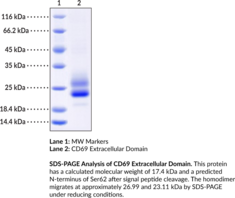
CD69 is a membrane-bound type II C-lectin receptor and early activation marker of leukocytes.1,2,3 It is composed of an extracellular C-type lectin domain, a neck region, a transmembrane domain, and a cytoplasmic tail and exists as a homodimer.3 CD69 is expressed in activated hematopoietic cells, such as T cells, B cells, and platelets, as well as neutrophils, eosinophils, and epidermal Langerhans cells.4 It is involved in many biological processes, including T cell differentiation, cell migration, immune checkpoint regulation, and metabolic reprogramming, and acts as a receptor for various ligands, such as galectin-1 (Gal-1) and oxidized low-density lipoprotein (oxLDL).1,2,3 CD69 also acts as an agonist of sphingosine-1-phosphate receptor 1 (S1P1).2,3,5 Increased intratumoral levels of CD69 are associated with poor prognosis in patients with hepatocellular carcinoma.6 Cayman’s CD69 Extracellular Domain (human, recombinant) protein is a disulfide-linked homodimer. The reduced monomer, composed of CD69 (amino acids 62-199) fused to a signal peptide and His-tag at the N- and C-terminus, respectively, consists of 149 amino acids, has a calculated molecular weight of 17.4 kDa, and a predicted N-terminus of Ser62 after signal peptide cleavage. The homodimer migrates at approximately 26.99 and 23.11 kDa by SDS-PAGE under reducing conditions.
WARNING This product is not for human or veterinary use.
References & Product Citations
1. Unraveling CD69 signaling pathways, ligands and laterally associated molecules. EXCLI J. 22, 334-351 (2023).
2. CD69: From activation marker to metabolic gatekeeper. Eur. J. Immunol. 47(6), 946-953 (2017).
3. CD69 is the crucial regulator of intestinal inflammation: A new target molecule for IBD treatment? J. Immunol. Res. 497056 (2015).
4. Expression cloning of the early activation antigen CD69, a type II integral membrane protein with a C-
5. Transmembrane protein CD69 acts as an S1PR1 agonist. bioRxiv [Preprint] (2023).
6. CD69 serves as a potential diagnostic and prognostic biomarker for hepatocellular carcinoma. Sci. Rep. 13(1), 7452 (2023).
Contact Info
Cayman Chemical1180 East Ellsworth RoadAnn Arbor, Michigan 48108 USAToll Free: (800) 364-9897(USA and Canada only)Fax: (734) 971-3640


