
Technical Support & Resources
Visit our FAQ
Contact Us
Toll Free Phone (USA and Canada Only): (888) 526-5351
Direct Phone: (734) 975-3888
Technical Information
- Cluster of Differentiation 133
- PROM1
Shipping & Storage Information
Recommended Products
Certificates of Analysis & Batch Specific Data
Provide batch numbers separated by commas to download or request available product inserts, QC sheets, certificates of analysis, data packs, and GC-MS data.

Visit Our Cancer Resource Center
Find Tools & Resources to Study the Hallmarks of Cancer
- Cancer cell signaling & regulation
- Cancer metabolism
- Tumor microenvironment
Product Description
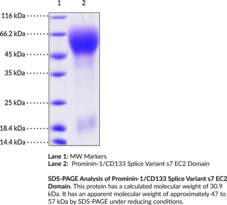
CD133, also known as prominin-1, is a five-transmembrane domain glycoprotein and stem cell marker.1 It is composed of an N-terminal extracellular domain (EC1) and two extracellular loops (EC2 and EC3), which are linked via two intracellular loops (IC1 and IC2), and a C-terminal cytoplasmic domain (IC3). CD133 localizes to membrane protrusions and undergoes extensive alternative splicing, where each splice variant is expressed in a tissue-dependent manner.1,2,3 In addition to its expression in stem cells, CD133 is also expressed in some differentiated epithelial cells, such as in the proximal tubules of the kidneys, epididymal tract, and various glands, and differentiated nonepithelial cells, including photoreceptor cells.1 It is involved in regulating membrane architecture of microvilli and cilia, stem cell transit, autophagy, interactions with lipid rafts, and intercellular communication, among other processes. CD133 is commonly used as an antigen to isolate stem cells, including cancer stem cells, from biological samples.1,4 Mutations in PROM1, the gene encoding CD133, are associated with macular degeneration.5 Cayman’s Prominin-1/CD133 Splice Variant s7 EC2 Domain (rat, recombinant) protein consists of 274 amino acids and has a calculated molecular weight of 30.9 kDa. By SDS-PAGE, under reducing conditions, the apparent molecular mass of the protein is approximately 47 to 57 kDa.
WARNING This product is not for human or veterinary use.
References & Product Citations
1. Emerging roles of prominin-
2. Nomenclature of prominin-
3. Alternative promoters regulate transcription of the gene that encodes stem cell surface protein AC133. Blood 103(6), 2055-2061 (2004).
4. Characterization of a side population of cancer cells from human gastrointestinal system. Stem Cells (2005).
5. Mutant prominin 1 found in patients with macular degeneration disrupts photoreceptor disk morphogenesis in mice. J. Clin. Invest. 118(8), 2908-2916 (2008).
Contact Info
Cayman Chemical1180 East Ellsworth RoadAnn Arbor, Michigan 48108 USAToll Free: (800) 364-9897(USA and Canada only)Fax: (734) 971-3640


