
Technical Support & Resources
Visit our FAQ
Contact Us
Toll Free Phone (USA and Canada Only): (888) 526-5351
Direct Phone: (734) 975-3888
Product Categories
Product Type
Application
Technical Information
- CD130
- CDw130
- gp130
- gp130/IL6ST
- IL-6 Receptor Subunit β
- IL-6RB
- IL-6R Subunit β
- Interleukin-6 Receptor Subunit β
- Interleukin-6 Signal Transducer
- Membrane Glycoprotein 130
- Oncostatin-M Receptor Subunit α
Shipping & Storage Information
Recommended Products
Certificates of Analysis & Batch Specific Data
Provide batch numbers separated by commas to download or request available product inserts, QC sheets, certificates of analysis, data packs, and GC-MS data.
Product Description
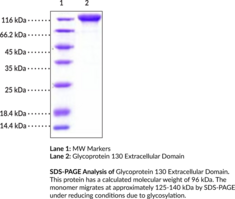
Glycoprotein 130 (gp130), also known as IL-6 signal transducer (IL6ST), is a single-pass type I membrane protein and shared signal transducing receptor for the IL-6 cytokine family.1 It is composed of an N-terminal immunoglobulin-like domain, two cytokine-binding domains, three fibronectin type III-like domains, a transmembrane domain, and a cytoplasmic domain, which contains JAK and STAT binding sites.2,3,4 Soluble forms of gp130 are formed via alternative splicing of the extracellular domain.3 gp130 is ubiquitously expressed and its membrane-bound form associates with membrane-bound cytokine-cytokine receptor complexes via the classical signaling pathway to induce JAK/STAT signaling.4,1,5 In contrast, in the trans-signaling pathway, membrane-bound cytokines and soluble cytokine receptors form a complex that can associate with either membrane-bound or soluble gp130, and high concentrations of soluble gp130 lead to signaling inhibition.5,3 Due to the variety of cytokines that utilize it for signaling, gp130 is involved in many biological processes, including immune signaling, organ and neural development, and bone homeostasis.4 Loss-of-function mutations in IL6ST are associated with hyper-IgE syndrome, extended Stüve-Wiedemann syndrome, or craniosynostosis, while a gain-of-function mutation is associated with inflammatory hepatocellular adenoma. Cayman’s Glycoprotein 130 Extracellular Domain (human, recombinant) protein can be used for cell-based assays. This protein is a disulfide-linked homodimer. The reduced monomer, composed of gp130 (amino acids 23-618) fused to His-tagged human IgG1 Fc at its C-terminus, consists of 844 amino acids and has a calculated molecular weight of 96 kDa. As a result of glycosylation, the monomer migrates at approximately 125-140 kDa by SDS-PAGE under reducing conditions.
WARNING This product is not for human or veterinary use.
References & Product Citations
1. Hyper-
2. Determination of the disulfide structure and N-
3. The IL6-
4. The human GP130 cytokine receptor and its expression-
5. Targeting IL-
Contact Info
Cayman Chemical1180 East Ellsworth RoadAnn Arbor, Michigan 48108 USAToll Free: (800) 364-9897(USA and Canada only)Fax: (734) 971-3640


