
Technical Support & Resources
Visit our FAQ
Contact Us
Toll Free Phone (USA and Canada Only): (888) 526-5351
Direct Phone: (734) 975-3888
Product Categories
Technical Information
- 1-O-Acylceramide Synthase
- LCAT-Like Lysophospholipase
- LLPL
- LPLA2
- LYPLA3
- Lysophospholipase 3
- Lysosomal Phospholipase A and Acyltransferase
- Lysosomal Phospholipase A2
- Phospholipase A2 Group XV
Shipping & Storage Information
Recommended Products
Certificates of Analysis & Batch Specific Data
Provide batch numbers separated by commas to download or request available product inserts, QC sheets, certificates of analysis, data packs, and GC-MS data.
Lipid Resource Center
Discover Products & Resources for Lipid Research
- High-purity lipid standards
- Lipid roles in biology
- Lipids in health & disease
- Lipids for pharmaceutical development
- Protocols, advice, & resources
Product Description
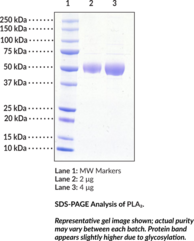
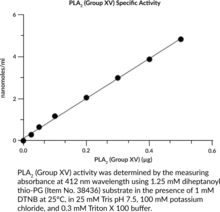
Phospholipase A2 (PLA2) (Group XV), also known as lysosomal phospholipase A and acetyltransferase, is a calcium-independent and acidic pH-optimum phospholipase encoded by PLA2G15 in humans.1,2 It is composed of an α/β-hydrolase domain, a cap domain, and a membrane-binding domain, is ubiquitously expressed, and localizes to lysosomes.1,3 PLA2 (Group XV) hydrolyzes sn-1 and sn-2 fatty acids in phospholipids, contributing to phospholipid degradation in lysosomes.1 It also functions as a bis(monoacylglycerol) phosphate (BMP) hydrolase, hydrolyzing BMP lipid species independent of their saturation or chain length.4 Pla2g15 knockdown induces phospholipidosis and enlargement of alveolar macrophages, mimicking a foam cell phenotype, in young mice. In aged mice, Pla2g15 knockdown induces the development of glomerulonephritis, lymphoid hypertrophy, and abnormal serologies, including positive anti-nuclear antibodies, anti-dsDNA antibodies, and high circulating immunoglobulin levels, indicating an autoimmune phenotype similar to systemic lupus erythematosus (SLE). Similar to PLA2G15 knockout, pharmacologic inhibition of PLA2 (Group XV) by cationic amphiphilic drugs, such as amiodarone, induces phospholipidosis in cells, indicating that PLA2 (Group XV) may be a screening candidate for prediction of drug-induced phospholipidosis during pre-clinical drug development studies.5 Pla2g15 knockdown reduces Purkinje cell loss, microgliosis, astrocytosis, and CNS demyelination in a mouse model of Niemann-Pick disease type C1 (NPC1).4 Cayman’s PLA2 (human, recombinant Group XV) can be used for enzyme activity assay and Western blot (WB) applications.
WARNING This product is not for human or veterinary use.
References & Product Citations
1. Group XV phospholipase A2, a lysosomal phospholipase A2. Prog. Lipid Res. 50(1), 1-13 (2010).
2. Updating Phospholipase A2 Biology. Biomolecules 10(10), 1457 (2020).
3. Lysosomal phospholipase A2. Biochim. Biophys. Acta Mol. Cell Biol. Lipids 1864(6), 932-940 (2019).
4. PLA2G15 is a BMP hydrolase and its targeting ameliorates lysosomal disease. Nature 642(8067), 474-483 (2025).
5. Drug induced phospholipidosis: An acquired lysosomal storage disorder. Biochim. Biophys. Acta 1831(3), 602-611 (2013).
Contact Info
Cayman Chemical1180 East Ellsworth RoadAnn Arbor, Michigan 48108 USAToll Free: (800) 364-9897(USA and Canada only)Fax: (734) 971-3640


