Technical Support & Resources
Visit our FAQ
Contact Us
Toll Free Phone (USA and Canada Only): (888) 526-5351
Direct Phone: (734) 975-3888
Product Categories
Application
Technical Information
- EPHX1
- Epoxide Hydratase
- Epoxide Hydrolase 1
- mEH
Shipping & Storage Information
Recommended Products
Certificates of Analysis & Batch Specific Data
Provide batch numbers separated by commas to download or request available product inserts, QC sheets, certificates of analysis, data packs, and GC-MS data.

Visit Our Cancer Resource Center
Find Tools & Resources to Study the Hallmarks of Cancer
- Cancer cell signaling & regulation
- Cancer metabolism
- Tumor microenvironment
Product Description
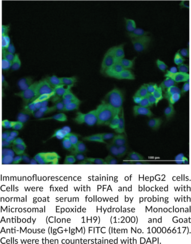
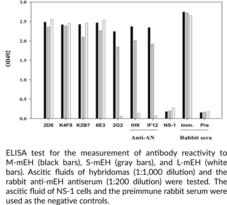
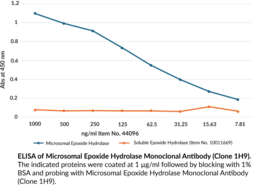
Microsomal epoxide hydrolase (mEH) is a member of the α/β-hydrolase family that catalyzes the hydrolysis of xenobiotic and endogenous epoxides to diols.1,2,3 It is a single polypeptide chain with the N-terminal region functioning as a membrane anchor and the C-terminus containing the catalytic residues.1 mEH is localized to the endoplasmic reticulum and ubiquitously expressed, but becomes pseudo-soluble under a variety of pathological conditions.1,3 mEH dissociates from the endoplasmic reticulum in neoplastic and preneoplastic liver cells and plasma levels of mEH are positively correlated with the metastasis of Kaposi’s sarcoma to the liver.3,4 Viral infection by hepatitis C or hepatitis A also induces pseudo-solubilization of mEH and the development of autoantibodies against mEH, which are associated with liver damage and disease progression.3,5 Cayman’s Microsomal Epoxide Hydrolase Monoclonal Antibody (Clone 1H9) can be used for ELISA and immunofluorescence (IF) applications.
WARNING This product is not for human or veterinary use.
References & Product Citations
1. Microsomal epoxide hydrolase 1 (EPHX1): Gene, structure, function, and role in human disease. Gene 571(1), 1-8 (2015).
2. Development of monoclonal antibodies to human microsomal epoxide hydrolase and analysis of "preneoplastic antigen"-
3. The generation of a nanobody-
4. A methodology for the analysis of the preneoplastic antigen. Carcinogenesis 5(11), 1467-1473 (1984).
5. Autoantibody response to microsomal epoxide hydrolase in hepatitis C and A. J. Autoimmun. 28(1), 7-18 (2007).
Contact Info
Cayman Chemical1180 East Ellsworth RoadAnn Arbor, Michigan 48108 USAToll Free: (800) 364-9897(USA and Canada only)Fax: (734) 971-3640