
Technical Support & Resources
Visit our FAQ
Contact Us
Toll Free Phone (USA and Canada Only): (888) 526-5351
Direct Phone: (734) 975-3888
Product Categories
Product Type
Application
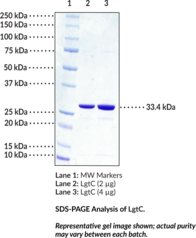
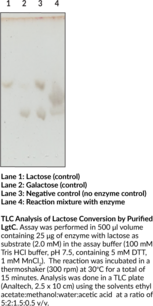
Technical Information
- LgtC Glycosyltransferase
- Lipopolysaccharyl α-galactosyltransferase
- Lipopolysaccharyl-1,4-galactosyltransferase
Shipping & Storage Information
Recommended Products
Certificates of Analysis & Batch Specific Data
Provide batch numbers separated by commas to download or request available product inserts, QC sheets, certificates of analysis, data packs, and GC-MS data.
Neutrophil Biology Wall Poster
Explore how neutrophils shape the immune response in health and disease. This poster highlights neutrophil pathogen defense mechanisms, including phagocytosis, degranulation, and NETosis, as well as neutrophil roles in inflammation and NET-associated pathologies.
DOWNLOAD NOWProduct Description
Lipopolysaccharide α-1,4-galactosyltransferase (LgtC) is a retaining glycosyltransferase and member of glycosyltransferase family 8 (GT8) that is found in N. meningitidis, an opportunistic bacterium that can cause meningitis.1 It is composed of an N-terminal mixed α/β domain, which contains the active site, and a C-terminal helical domain, which is responsible for attachment to cell membranes.2,3 LgtC transfers a galactosyl moiety from UDP-galactose (UDP-Gal) to the terminal lactose moiety on lipooligosaccharides (LOSs) while retaining the configuration of the donor sugar glycosidic bond.3 Isolated LgtC has been used in the analysis of newborn dried blood spots as a potential screening assay for galactosemia, an inborn error of metabolism characterized by a deficiency in galactose-1-phosphate uridylyltransferase (GALT), the enzyme that converts UDP-glucose to UDP-galactose.4 Cayman’s LgtC (N. meningitidis) protein can be used for biocatalysis and enzyme activity assay applications.
WARNING This product is not for human or veterinary use.
References & Product Citations
1. Mechanistic studies of a retaining α-
2. Nuclear magnetic resonance spectral assignments of α-
3. Crystal structure of the retaining galactosyltransferase LgtC from Neisseria meningitidis in complex with donor and acceptor sugar analogs. Nat. Struct. Biol. 8(2), 166-175 (2001).
4. Multiplex tandem mass spectrometry assay for newborn screening of X-
Contact Info
Cayman Chemical1180 East Ellsworth RoadAnn Arbor, Michigan 48108 USAToll Free: (800) 364-9897(USA and Canada only)Fax: (734) 971-3640


