
Technical Support & Resources
Visit our FAQ
Contact Us
Toll Free Phone (USA and Canada Only): (888) 526-5351
Direct Phone: (734) 975-3888
Product Categories
Product Type
Application
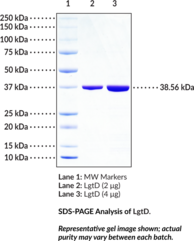
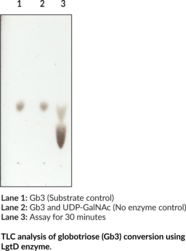
Technical Information
- LgtD
- UDP-GlcNAc Lipooligosaccharide N-Acetylglucosamine Glycosyltransferase
Shipping & Storage Information
Recommended Products
Certificates of Analysis & Batch Specific Data
Provide batch numbers separated by commas to download or request available product inserts, QC sheets, certificates of analysis, data packs, and GC-MS data.

Neutrophil Biology Wall Poster
Explore how neutrophils shape the immune response in health and disease. This poster highlights neutrophil pathogen defense mechanisms, including phagocytosis, degranulation, and NETosis, as well as neutrophil roles in inflammation and NET-associated pathologies.
DOWNLOAD NOWProduct Description
Lipopolysaccharyl β-1,3-N-acetylgalactosaminyltransferase (LgtD) is an inverting N-acetylgalactosaminyltransferase and a member of glycosyltransferase family 2 (GT2) that is found in H. influenzae.1,2 A similar protein, lipopolysaccharide α-1,4-galactosyltransferase (LgtC) that is found in N. meningitidis, is composed of an N-terminal mixed α/β domain, which contains the active site, and a C-terminal helical domain, which is responsible for attachment to cell membranes.3,4 LgtD transfers an N-acetylgalactosamine from UDP-N-acetylgalactosamine (UDP-GalNAc) onto globotriose in the biosynthesis of the glycosphingolipid antigen globohexasaccharide (globoH) or globotetraose-containing LPS.5,6 Cayman's Lipopolysaccharyl β-1,3-N-acetylgalactosaminyltransferase (H. influenzae F3031, recombinant) protein can be used for enzyme activity assays.
WARNING This product is not for human or veterinary use.
References & Product Citations
1. Overexpression and biochemical characterization of β-
2. A classification of nucleotide-
3. Enhanced expression of recombinant human cyclooxygenase 1 from stably-
4. Crystal structure of the retaining galactosyltransferase LgtC from Neisseria meningitidis in complex with donor and acceptor sugar analogs. Nat. Struct. Biol. 8(2), 166-175 (2001).
5. Enzymatic synthesis of tumor-
6. Genetic basis for expression of the major globotetraose-
Contact Info
Cayman Chemical1180 East Ellsworth RoadAnn Arbor, Michigan 48108 USAToll Free: (800) 364-9897(USA and Canada only)Fax: (734) 971-3640


