
Technical Support & Resources
Visit our FAQ
Contact Us
Toll Free Phone (USA and Canada Only): (888) 526-5351
Direct Phone: (734) 975-3888
Product Categories
Product Type
Technical Information
- Adhesion Molecule Interacting with CXADR Antigen 1
- AMICA
- CREA7-1
- CREA7-4
- Dendritic Cell-specific Protein
- Junctional Adhesion Molecule-like
Shipping & Storage Information
Recommended Products
Certificates of Analysis & Batch Specific Data
Provide batch numbers separated by commas to download or request available product inserts, QC sheets, certificates of analysis, data packs, and GC-MS data.

Visit Our Cancer Resource Center
Find Tools & Resources to Study the Hallmarks of Cancer
- Cancer cell signaling & regulation
- Cancer metabolism
- Tumor microenvironment
Product Description
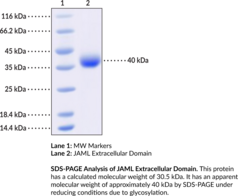
Junctional adhesion molecule-like (JAML) is a junctional adhesion molecule and member of the immunoglobulin superfamily with roles in maintenance of tight junctions and immune regulation.1,2 It is composed of an N-terminal extracellular domain, which contains two immunoglobulin-like domains, a transmembrane domain, and a C-terminal cytoplasmic tail.1 JAML is expressed by neutrophils, monocytes, activated CD8+ T cells, αβ T cells, tissue-resident γδ T cells, and renal podocytes and localizes to the plasma membrane at cell-cell contact regions but is absent at free cell boundaries.1,2 It regulates leukocyte adhesion and transendothelial migration, functions as a co-regulatory receptor for T cell activation, and regulates lipid metabolism in podocytes.3,4 Podocyte-specific Jaml knockout reduces podocyte injury and proteinuria in db/db diabetic mice and in a mouse model of doxorubicin-induced nephropathy.4 Increased JAML expression is associated with improved median and overall survival in patients with subcutaneous melanoma.2 Cayman’s JAML Extracellular Domain (human, recombinant) protein consists of 267 amino acids, has a calculated molecular weight of 30.5 kDa and a predicted N-terminus of Leu20 after signal peptide cleavage. By SDS-PAGE, under reducing conditions, the apparent molecular mass of the protein is 40 kDa due to glycosylation.
WARNING This product is not for human or veterinary use.
References & Product Citations
1. The distinct biological role of JAML positions it as a promising target for treating human cancers and a range of other diseases. Front. Immunol. 16, 1558488 (2025).
2. JAML promotes CD8 and γδ T cell antitumor immunity and is a novel target for cancer immunotherapy. J. Exp. Med. 218(10), e20202644 (2021).
3. JAML promotes acute kidney injury mainly through a macrophage-
4. Elevation of JAML promotes diabetic kidney disease by modulating podocyte lipid metabolism. Cell Metab. 32(6), 1052-1062 (2020).
Contact Info
Cayman Chemical1180 East Ellsworth RoadAnn Arbor, Michigan 48108 USAToll Free: (800) 364-9897(USA and Canada only)Fax: (734) 971-3640


