
Technical Support & Resources
Visit our FAQ
Contact Us
Toll Free Phone (USA and Canada Only): (888) 526-5351
Direct Phone: (734) 975-3888
Product Categories
Product Type
Technical Information
- CAML1
- CD171
- L1CAM
- L1 Cell Adhesion Molecule
- NCAML1
- Neural Cell Adhesion Molecule L1
Shipping & Storage Information
Recommended Products
Certificates of Analysis & Batch Specific Data
Provide batch numbers separated by commas to download or request available product inserts, QC sheets, certificates of analysis, data packs, and GC-MS data.

Visit Our Cancer Resource Center
Find Tools & Resources to Study the Hallmarks of Cancer
- Cancer cell signaling & regulation
- Cancer metabolism
- Tumor microenvironment
Product Description
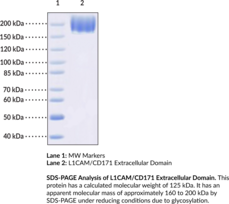
L1 cell adhesion molecule (L1CAM), also known as CD171, is a transmembrane glycoprotein and member of the L1 family of neural adhesion proteins.1,2 It is composed of six immunoglobulin (Ig) domains, five fibronectin type III-like domains, a transmembrane domain, and a short C-terminal domain.1 L1CAM is found in central and peripheral neurons, oligodendrocytes, immune cells, and cancer cells.3 It can interact with other L1CAM receptors in a cis confirmation and bind receptors, such as reelin or integrins, on other cells in a trans confirmation.2,4 L1CAM is generally involved in cell-cell binding, neural signaling, and signal transduction through C-terminal interactions with ezrin and focal adhesion kinase (FAK).2 The extracellular domain of L1CAM can be cleaved by serine proteases and promotes angiogenesis, invasion and metastasis, and cell survival and proliferation in tumors.5 The residual intracellular C-terminal fragment can be translocated to the nucleus where it promotes formation of neurite outgrowth and induces neuron migration.2 Truncating or missense mutations in L1CAM are found in patients with L1 syndrome, a group of neonatal conditions characterized by intellectual disability, hydrocephaly, involuntary spasms, and adducted thumbs.4 Cayman's L1CAM/CD171 Extracellular Domain (human, recombinant) protein consists of 1,112 amino acids, has a calculated molecular weight of 125 kDa, and a predicted N-terminus of Ile20 after signal peptide cleavage. By SDS-PAGE, under reducing conditions, the apparent molecular mass of the protein is 160-200 kDa due to glycosylation.
WARNING This product is not for human or veterinary use.
References & Product Citations
1. L1CAM in human cancer. Int. J. Cancer. 138(7), 1565-1576 (2016).
2. Functional diversity of neuronal cell adhesion and recognition molecule L1CAM through proteolytic cleavage. Cells 11(19), 3085 (2022).
3. L1CAM-
4. CRASH syndrome: Does it teach us about neurotrophic functions of cell adhesion molecules? Neuroscientist 16(4), 470-474 (2010).
5. L1CAM: A major driver for tumor cell invasion and motility. Cell Adh. Migr. 6(4), 374-384 (2012).
Contact Info
Cayman Chemical1180 East Ellsworth RoadAnn Arbor, Michigan 48108 USAToll Free: (800) 364-9897(USA and Canada only)Fax: (734) 971-3640


