
Technical Support & Resources
Visit our FAQ
Contact Us
Toll Free Phone (USA and Canada Only): (888) 526-5351
Direct Phone: (734) 975-3888
Product Categories
Product Type
Application
Technical Information
- Leptin Receptor
- LEP-R
- Obesity Receptor
- OB-R
Shipping & Storage Information
Recommended Products
Certificates of Analysis & Batch Specific Data
Provide batch numbers separated by commas to download or request available product inserts, QC sheets, certificates of analysis, data packs, and GC-MS data.
Lipid Resource Center
Discover Products & Resources for Lipid Research
- High-purity lipid standards
- Lipid roles in biology
- Lipids in health & disease
- Lipids for pharmaceutical development
- Protocols, advice, & resources
Product Description
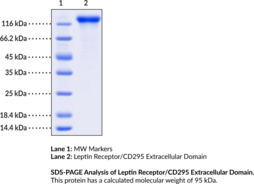
Leptin receptor, also known as CD295, is a leptin-binding transmembrane receptor with roles in the regulation of food intake, energy homeostasis, and lipid metabolism.1,2 It is composed of a multi-domain extracellular region comprising an N-terminal domain, a cytokine receptor homology (CRH1) domain, an immunoglobulin-like (Ig-like) domain, a CRH2 domain that binds leptin, and a fibronectin type III (FNIII) domain, a transmembrane domain, and an intracellular signaling domain.1 The leptin receptor is encoded by LEPR in humans and undergoes alternative splicing to form six isoforms, all of which are expressed in a tissue-dependent manner, contain identical extracellular regions, and have variable intracellular domains.1,2,3 Leptin receptor deficiency is induced by mutations in LEPR and is associated with hypothyroidism, hypogonadotropic hypogonadism, growth hormone deficiency, and extreme early-onset obesity.4 Cayman’s Leptin Receptor/CD295 Extracellular Domain (human, recombinant) protein can be used for binding assay and Western blot (WB) applications. This protein consists of 829 amino acids, has a calculated molecular weight of 95 kDa, and a predicted N-terminus of Phe22 after signal peptide cleavage. By SDS-PAGE, under reducing conditions, the apparent molecular mass of the protein is approximately 130-140 kDa due to glycosylation.
WARNING This product is not for human or veterinary use.
References & Product Citations
1. Leptin receptor compound heterozygosity in humans and animal models. Int. J. Mol. Sci. 22(9), 4475 (2021).
2. The leptin receptor. The Journal of Biological Chemisty 272(10), 6093-6096 (1997).
3. Leptin receptor action and mechanisms of leptin resistance. Cell Mol. Life Sci. 62(6), 642-652 (2005).
4. Leptin receptor deficiency: A systematic literature review and prevalence estimation based on population genetics. Eur. J. Endocrinol. 182(1), 47-56 (2020).
Contact Info
Cayman Chemical1180 East Ellsworth RoadAnn Arbor, Michigan 48108 USAToll Free: (800) 364-9897(USA and Canada only)Fax: (734) 971-3640


