
Technical Support & Resources
Visit our FAQ
Contact Us
Toll Free Phone (USA and Canada Only): (888) 526-5351
Direct Phone: (734) 975-3888
Product Categories
Product Type
Technical Information
- ICAM-1
- Intercellular Adhesion Molecule-1
Shipping & Storage Information
Recommended Products
Certificates of Analysis & Batch Specific Data
Provide batch numbers separated by commas to download or request available product inserts, QC sheets, certificates of analysis, data packs, and GC-MS data.

Visit Our Cancer Resource Center
Find Tools & Resources to Study the Hallmarks of Cancer
- Cancer cell signaling & regulation
- Cancer metabolism
- Tumor microenvironment
Product Description
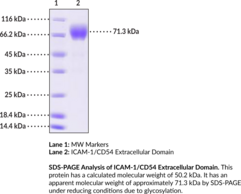
Intercellular adhesion molecule-1 (ICAM-1), also known as CD54, is a cell surface glycoprotein and member of the Ig superfamily.1 It is composed of five extracellular Ig domains, which can vary in number through alternative splicing, a transmembrane domain, and a short C-terminal cytoplasmic domain.2,3 ICAM-1 is basally expressed at low levels but cytokines, such as NF-κB, TNF-α, and IL-1α, increase ICAM-1 levels in endothelial, epithelial, and immune cells.4 It binds integrins, such as lymphocyte function-associated antigen-1 (LFA-1) and complement 3 receptor (C3R), and directs lymphocytes or other immune cells to locally inflamed areas, among other roles in forming epithelial and endothelial barriers, regulating cell migration, and immune signaling.5,1,2 ICAM-1 can be cleaved from the cell membrane by cathepsin G or neutrophil elastase and promote or antagonize inflammation in a context-dependent manner and induce wound healing.1,3 Blood levels of soluble ICAM-1 are increased in patients with cancer, and serum levels of soluble ICAM-1 are increased in patients with acute ischemic stroke.6,7 Cayman's ICAM-1/CD54 Extracellular Domain (human, recombinant) protein consists of 459 amino acids and has a calculated molecular weight of 50.2 kDa. By SDS-PAGE, under reducing conditions, the apparent molecular mass of the protein is 71.3 kDa due to glycosylation.
WARNING This product is not for human or veterinary use.
References & Product Citations
1. ICAM-
2. Structural basis for dimerization of ICAM-
3. ICAM-
4. Mycotrienin II, a translation inhibitor that prevents ICAM-
5. Prostaglandin E2/EP1 signaling pathway enhances intercellular adhesion molecule 1 (ICAM-
6. Circulating intercellular adhesion molecule-
7. Serum levels of intracellular adhesion molecule-
Contact Info
Cayman Chemical1180 East Ellsworth RoadAnn Arbor, Michigan 48108 USAToll Free: (800) 364-9897(USA and Canada only)Fax: (734) 971-3640


