
Technical Support & Resources
Visit our FAQ
Contact Us
Toll Free Phone (USA and Canada Only): (888) 526-5351
Direct Phone: (734) 975-3888
Product Categories
Product Type
Technical Information
- Alkaline Phosphatase
- Alkaline Phosphatase Liver/Bone/Kidney Isozyme
- Phosphoamidase
- Phosphocreatine Phosphatase
- Tissue Non-specific Alkaline Phosphatase
- Tissue Non-specific Enzyme Isozyme
- TNSALP
Shipping & Storage Information
Recommended Products
Certificates of Analysis & Batch Specific Data
Provide batch numbers separated by commas to download or request available product inserts, QC sheets, certificates of analysis, data packs, and GC-MS data.
Product Description
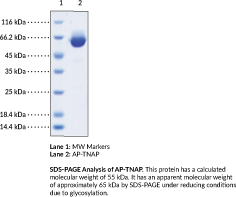
Alkaline phosphatase, tissue non-specific enzyme (AP-TNAP) is a monoester phosphohydrolase with roles in bone mineralization and early embryonic development of the CNS.1,2,3 It is ubiquitously expressed but is enriched in liver, bone, kidney, and the CNS and is found in the cytoplasmic membrane. AP-TNAP hydrolyzes extracellular inorganic pyrophosphate, a mineralization inhibitor, to facilitate the deposition of hydroxyapatite in bones and teeth.3 It also converts pyridoxal-5’-phosphate, an active form of vitamin B6, into pyridoxal, which functions as a cofactor for the synthesis of enzymes involved in the metabolism of several neurotransmitters. Mutations in ALPL, the gene encoding AP-TNAP, are associated with hypophosphatasia, an inborn error of metabolism characterized by severe skeletal hypomineralization, respiratory problems, and seizures, among other symptoms.4,5 AP-TNAP activity is increased in the hippocampus of patients with Alzheimer’s disease compared with age-related controls.3 Cayman’s AP-TNAP (human, recombinant) protein can be used for enzyme activity assay and Western blot (WB) applications. This protein consists of 496 amino acids, has a calculated molecular weight of 55 kDa, and a predicted N-terminus of Leu18 after signal peptide cleavage. By SDS-PAGE, under reducing conditions, this protein has an apparent molecular mass of 65 kDa due to glycosylation.
WARNING This product is not for human or veterinary use.
References & Product Citations
1. Physiological role of alkaline phosphatase explored in hypophosphatasia. Ann. N. Y. Acad. Sci. 1192, 190-200 (2010).
2. Tissue-
3. Tissue-
4. Large-
5. Hypophosphatasia -
Contact Info
Cayman Chemical1180 East Ellsworth RoadAnn Arbor, Michigan 48108 USAToll Free: (800) 364-9897(USA and Canada only)Fax: (734) 971-3640


