
Technical Support & Resources
Visit our FAQ
Contact Us
Toll Free Phone (USA and Canada Only): (888) 526-5351
Direct Phone: (734) 975-3888
Technical Information
- Frizzled-5
- Fz5
Shipping & Storage Information
Certificates of Analysis & Batch Specific Data
Provide batch numbers separated by commas to download or request available product inserts, QC sheets, certificates of analysis, data packs, and GC-MS data.

Visit Our Cancer Resource Center
Find Tools & Resources to Study the Hallmarks of Cancer
- Cancer cell signaling & regulation
- Cancer metabolism
- Tumor microenvironment
Product Description
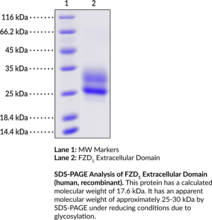
Frizzled family G protein-coupled receptor 5 (FZD5) is a Wnt receptor involved in canonical and non-canonical Wnt/β-catenin signaling.1 It is composed of an extracellular cysteine-rich ligand-binding domain, seven transmembrane domains, and an intracellular C-terminal domain that binds the PDZ domain of dishevelled (Dvl) and G proteins.2,3,4 Fzd5 is expressed in the yolk sac, eye, and lung during development and primarily in the eye, kidney, lung, and testis in adults.5,6 Upon ligand-binding, FZD5 associates with LDL receptor-related protein 5/6 (LRP5/6) and recruits Dvl, which leads to phosphorylation of LRP5/6, recruitment of Axin, and subsequent accumulation of β-catenin.3,7 It is involved in ocular development, mesenchymal stem cell senescence, and intestinal crypt homeostasis, and plays pro- and anti-tumorigenic roles in a context-dependent manner.1,4,5,8,9,10 A frameshift mutation in FZD5 that results in production of a secreted FZD5 extracellular domain is associated with autosomal dominant coloboma.1 Cayman’s FZD5 Extracellular Domain (human, recombinant) protein can be used for binding assays. This protein consists of 152 amino acids, has a calculated molecular weight of 17.6 kDa, and a predicted N-terminus of Ala27 after signal peptide cleavage. By SDS-PAGE, under reducing conditions, the apparent molecular mass of the protein is 25-30 kDa due to glycosylation.
WARNING This product is not for human or veterinary use.
References & Product Citations
1. A secreted WNT-
2. Structural diversity of G protein-
3. Oligomerization of Frizzled and LRP5/6 protein initiates intracellular signaling for the canonical WNT/β-
4. FZD5 prevents epithelial-
5. Mouse Wnt receptor gene Fzd5 is essential for yolk sac and placental angiogenesis. Development 128(1), 25-33 (2001).
6. A large family of putative transmembrane receptors homologous to the product of the Drosophila tissue polarity gene frizzled. The Journal of Biological Chemisty 271(8), 4468-4476 (1996).
7. Wnt/β-
8. FZD5 regulates cellular senescence in human mesenchymal stem/stromal cells. Stem Cells 39(3), 318-330 (2021).
9. FZD5 controls intestinal crypt homeostasis and colonic Wnt surrogate agonist response. Dev. Cell 60(3), 342-351 (2025).
10. FZD5 contributes to TNBC proliferation, DNA damage repair and stemness. Cell Death Dis. 11(12), 1060 (2020).
Contact Info
Cayman Chemical1180 East Ellsworth RoadAnn Arbor, Michigan 48108 USAToll Free: (800) 364-9897(USA and Canada only)Fax: (734) 971-3640


