
Technical Support & Resources
Visit our FAQ
Contact Us
Toll Free Phone (USA and Canada Only): (888) 526-5351
Direct Phone: (734) 975-3888
Product Categories
Product Type
Technical Information
- Beta ig-h3
- BGH3
- BIGH3
- βIG-H3
- Kerato-epithelin
- RGD-CAP
- RGD-containing Collagen-associated Protein
- Transforming Growth Factor-beta-induced Protein ig-h3 Precursor
Shipping & Storage Information
Recommended Products
Certificates of Analysis & Batch Specific Data
Provide batch numbers separated by commas to download or request available product inserts, QC sheets, certificates of analysis, data packs, and GC-MS data.

Visit Our Cancer Resource Center
Find Tools & Resources to Study the Hallmarks of Cancer
- Cancer cell signaling & regulation
- Cancer metabolism
- Tumor microenvironment
Product Description
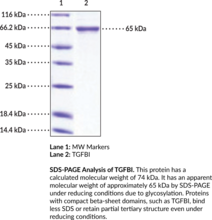
TGF-β-induced ig-h3 precursor (TGFBI) is a TGF-β-responsive extracellular protein.1 It is composed of an N-terminal signal peptide and cysteine-rich domain, four fasciclin 1 (FAS) repeats, and a C-terminal arginine-glycine-aspartate (RGD) motif.1 TGFBI is expressed in the mesenchyme during development and in the extracellular matrix in many tissues, including the cornea, bone, and kidney, in the adult.2 Its production is induced by TGF-β, and it inhibits cell adhesion by interacting with collagens, fibronectin, laminin, and vitronectin.2,3 In animal models, TGFBI acts as a tumor suppressor during cancer initiation and promotes progression during later stages, but both effects are dependent on cancer type.3 Mutations in TGFBI are associated with corneal dystrophies and lead to protein aggregation in the cornea and severe visual impairment or blindness.2,3 Cayman's TGFBI (human, recombinant) protein consists of 671 amino acids, has a calculated molecular weight of 74 kDa, and a predicted N-terminus of Gly24 after signal peptide cleavage. By SDS-PAGE, under reducing conditions, the apparent molecular mass of the protein is approximately 65 kDa due to glycosylation. Glycosylated proteins or proteins with compact beta-sheet domains, such as TGFBI, bind less SDS or retain partial tertiary structure even under reducing conditions.
WARNING This product is not for human or veterinary use.
References & Product Citations
1. Focus on molecules: Transforming growth factor beta induced protein (TGFBIp). Exp. Eye Res. 87(4), 298-299 (2008).
2. Purification and structural characterization of transforming growth factor beta induced protein (TGFBIp) from porcine and human corneas. Biochemistry 43(51), 16374-16384 (2004).
3. The role of the extracellular matrix protein TGFBI in cancer. Cell. Signal. 84, 110028 (2021).
Contact Info
Cayman Chemical1180 East Ellsworth RoadAnn Arbor, Michigan 48108 USAToll Free: (800) 364-9897(USA and Canada only)Fax: (734) 971-3640


