
Technical Support & Resources
Visit our FAQ
Contact Us
Toll Free Phone (USA and Canada Only): (888) 526-5351
Direct Phone: (734) 975-3888
Product Categories
Product Type
Technical Information
- SOST
Shipping & Storage Information
Recommended Products
Certificates of Analysis & Batch Specific Data
Provide batch numbers separated by commas to download or request available product inserts, QC sheets, certificates of analysis, data packs, and GC-MS data.
Product Description
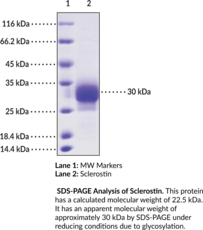
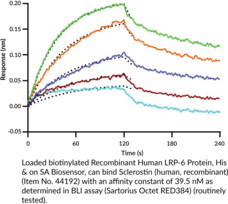
Sclerostin is a secreted glycoprotein and a member of the DAN/Cerberus protein family involved in Wnt signaling in bone.1,2,3 It contains a cystine-knot motif and heparin binding site and is expressed by osteocytes and cementocytes.3,4 Sclerostin competes with Wnt ligands for binding to LDL receptor-related protein 5/6 (LRP5/6), where it acts as a Wnt inhibitor and inhibits osteoblast activity.1,2 It also acts as an antagonist against several members of the bone morphogenetic protein (BMP) family. Inhibition of sclerostin via monoclonal antibodies increases bone mineral density in mice.3 Loss-of-function mutations in the gene encoding sclerostin, SOST, are associated with sclerosteosis, craniodiaphyseal dysplasia (CDD), and van Buchem disease.1 Formulations containing a monoclonal antibody against sclerostin have been used in the treatment of osteoporosis. Cayman’s Sclerostin (human, recombinant) protein can be used for binding assays. This protein consists of 197 amino acids and has a calculated molecular weight of 22.5 kDa. By SDS-PAGE, under reducing conditions, the apparent molecular mass of the protein is approximately 30 kDa due to glycosylation.
WARNING This product is not for human or veterinary use.
References & Product Citations
1. Sclerostin: Intracellular mechanisms of action and its role in the pathogenesis of skeletal and vascular disorders. Adv. Clin. Exp. Med. 26(8), 1283-1291 (2017).
2. Sclerostin and Dickkopf-
3. Characterization of the structural features and interactions of sclerostin: Molecular insight into a key regulator of Wnt-
4. Localization of SOST/sclerostin in cementocytes in vivo and in mineralizing periodontal ligament cells in vitro. J. Periodontal. Res. 45(2), 246-254 (2010).
Contact Info
Cayman Chemical1180 East Ellsworth RoadAnn Arbor, Michigan 48108 USAToll Free: (800) 364-9897(USA and Canada only)Fax: (734) 971-3640


