
Technical Support & Resources
Visit our FAQ
Contact Us
Toll Free Phone (USA and Canada Only): (888) 526-5351
Direct Phone: (734) 975-3888
Product Categories
Technical Information
- PLAU
- U-Plasminogen Activator
Shipping & Storage Information
Recommended Products
Certificates of Analysis & Batch Specific Data
Provide batch numbers separated by commas to download or request available product inserts, QC sheets, certificates of analysis, data packs, and GC-MS data.

Visit Our Cancer Resource Center
Find Tools & Resources to Study the Hallmarks of Cancer
- Cancer cell signaling & regulation
- Cancer metabolism
- Tumor microenvironment
Product Description
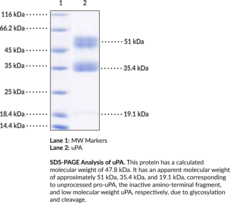
Urokinase-type plasminogen activator (uPA) is a serine protease that converts enzymatically inactive plasminogen into active plasmin.1,2 It is synthesized and released as a single polypeptide chain called pro-uPA, which contains three domains: a growth factor domain (GFD), a kringle domain, and a serine protease domain.2 The secreted polypeptide is cleaved by a variety of proteases, including cathepsin B, cathepsin L, trypsin, and plasmin, to form two-chain uPA. Two-chain uPA is further cleaved into two fragments: low molecular weight uPA containing the serine protease domain and a catalytically inactive amino-terminal fragment containing the GFD and kringle domain. Expression of PLAU, the gene encoding uPA, is increased several fold in tumor cells over non-tumor cells.1,2 Increased serum uPA levels are associated with an increased number of tumor metastases in patients with metastatic breast cancer.3 Cayman’s uPA (human, recombinant) protein can be used for enzyme activity assay and Western blot (WB) applications. This protein consists of 422 amino acids, has a calculated molecular weight of 47.8 kDa, and a predicted N-terminus of Ser21 after signal peptide cleavage. By SDS-PAGE, under reducing conditions, the apparent molecular mass of the protein is 51 kDa, 35.4 kDa, and 19.1 kDa, corresponding to unprocessed pro-uPA, the inactive amino-terminal fragment, and low molecular weight uPA, respectively, due to glycosylation and cleavage. This purified protein was activated by trypsin in vitro.
WARNING This product is not for human or veterinary use.
References & Product Citations
1. .
2. .
3. .
Contact Info
Cayman Chemical1180 East Ellsworth RoadAnn Arbor, Michigan 48108 USAToll Free: (800) 364-9897(USA and Canada only)Fax: (734) 971-3640


