
Technical Support & Resources
Visit our FAQ
Contact Us
Toll Free Phone (USA and Canada Only): (888) 526-5351
Direct Phone: (734) 975-3888
Product Categories
Product Type
Application
Technical Information
- ADP-ribosyl Cyclase 1
- Cyclic ADP-ribose Hydrolase 1
- cADPR Hydrolase 1
Shipping & Storage Information
Recommended Products
Certificates of Analysis & Batch Specific Data
Provide batch numbers separated by commas to download or request available product inserts, QC sheets, certificates of analysis, data packs, and GC-MS data.

Visit Our Cancer Resource Center
Find Tools & Resources to Study the Hallmarks of Cancer
- Cancer cell signaling & regulation
- Cancer metabolism
- Tumor microenvironment
Product Description
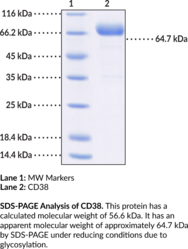
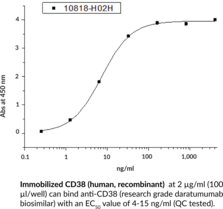
CD38, also known as ADP-ribosyl cyclase 1, is a single-chain type II transmembrane glycoprotein with enzymatic activity and cell surface receptor functions that has roles in calcium signaling and immunomodulation.1,2,3 It is composed of a C-terminal catalytic domain, which can be oriented towards the extracellular or intracellular environment, a transmembrane segment, and a short N-terminal cytoplasmic tail, which interacts with the tyrosine kinase Lck.1,4 CD38 expression is induced by cytokine, interferon, or endotoxin stimulation in a variety of immune cells, including T cells, B cells, granulocytes, and natural killer (NK) cells, as well as malignant plasma cells, and predominantly localizes to lipid rafts.1,2,3 It is also found in the nucleus and mitochondrial membrane, as well as in the cytoplasm.1 CD38 regulates calcium signaling by catalyzing the formation of the intracellular calcium mobilizing messengers cyclic ADP-ribose and nicotinic acid adenine dinucleotide phosphate (NAADP).5 It is a receptor for CD31, an adhesion molecule expressed by endothelial cells, and associates with a variety of signaling complexes, such as CD3/T cell receptor and CD19/CD21/B cell receptor complexes.1,3 CD38 protein expression is increased on plasma cells isolated from patients with multiple myeloma.6 Cayman's CD38 Extracellular Domain (human, recombinant) protein can be used for enzyme activity and binding assay applications. This protein is a disulfide-linked homodimer. The reduced monomer, composed of CD38 (amino acids 43-300) fused to human IgG1 Fc at its C-terminus, consists of 496 amino acids and has a calculated molecular weight of 56.6 kDa. As a result of glycosylation, the monomer migrates at approximately 64.7 kDa by SDS-PAGE under reducing conditions.
WARNING This product is not for human or veterinary use.
References & Product Citations
1. The multi-
2. CD38 as an immunotherapeutic target in multiple myeloma. Expert Opin. Biol. Ther. 18(12), 1209-1221 (2018).
3. CD38, a receptor with multifunctional activities: From modulatory functions on regulatory cell subsets and extracellular vesicles, to a target for therapeutic strategies. Cells 8(12), 1527 (2019).
4. Evolution and function of the ADP ribosyl cyclase/CD38 gene family in physiology and pathology. Physiol. Rev. 88(3), 841-886 (2008).
5. CD38 antibodies in multiple myeloma: Back to the future. Blood 131(1), 13-29 (2018).
6. Immuno-
Contact Info
Cayman Chemical1180 East Ellsworth RoadAnn Arbor, Michigan 48108 USAToll Free: (800) 364-9897(USA and Canada only)Fax: (734) 971-3640


