
Technical Support & Resources
Visit our FAQ
Contact Us
Toll Free Phone (USA and Canada Only): (888) 526-5351
Direct Phone: (734) 975-3888
Product Categories
Product Type
Technical Information
- Endothelial Cell Growth Inhibitor
- Iroplact
- C-X-C Motif Chemokine 4
- Oncostatin-A
- Platelet Factor 4
Shipping & Storage Information
Recommended Products
Certificates of Analysis & Batch Specific Data
Provide batch numbers separated by commas to download or request available product inserts, QC sheets, certificates of analysis, data packs, and GC-MS data.
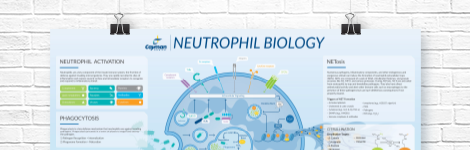
Neutrophil Biology Wall Poster
Explore how neutrophils shape the immune response in health and disease. This poster highlights neutrophil pathogen defense mechanisms, including phagocytosis, degranulation, and NETosis, as well as neutrophil roles in inflammation and NET-associated pathologies.
DOWNLOAD NOWProduct Description
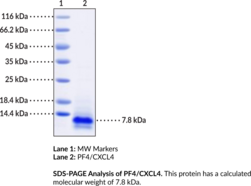
Platelet factor 4 (PF4), also known as chemokine (C-X-C) motif ligand 4 (CXCL4), is a chemokine produced by activated platelets with roles in coagulation, innate and adaptive immunity, and aging.1,2,3 It is produced as a 70-amino acid monomer, but functions as both a monomer and higher order oligomers in vivo.4 PF4 binds to heparin to inhibit its anticoagulation activity, and it facilitates platelet aggregation and interacts with chemokine (C-X-C) motif receptor 1 (CXCR1) and CXCR2 on polymorphonuclear leukocytes (PMNs) at sites of tissue injury to induce intramuscular accumulation and wound healing.5 It is released in response to microorganisms to induce neutrophil recruitment and in response to viral infection to stimulate antigen presenting cells and induce both pro- and antiviral effects.1 Plasma levels of PF4 are positively correlated with the progression of lung and skin fibrosis and pulmonary arterial hypertension.2 Decreased serum levels of PF4 are associated with cognitive decline in patients with Alzheimer’s disease.3 Cayman’s PF4/CXCL4 (human, recombinant) protein can be used for cell-based assay and Western blot (WB) applications. The protein was synthesized from a DNA sequence encoding the mature form of PF4 (Glu32-Ser101) with an N-terminal translation-initiating methionine (Met1). The expressed protein consists of 71 amino acids, has a calculated molecular weight of 7.8 kDa, and a predicted N-terminus of Met1.
WARNING This product is not for human or veterinary use.
References & Product Citations
1. Structural features and PF4 functions that occur in heparin-
2. Platelet factor 4(PF4) and its multiple roles in diseases. Blood Rev. 64, 101155 (2026).
3. PF4 in rejuvenation therapy: Neuroprotection and cognitive enhancement. Biomol. Biomed. 25(11), 2580-2584 (2025).
4. Crystal structure of recombinant human platelet factor 4. Biochemistry 33(27), 8361-8366 (1994).
5. Platelets: Signaling cells in the immune continuum. Trends Immunol. 25(9), 489-495 (2004).
Contact Info
Cayman Chemical1180 East Ellsworth RoadAnn Arbor, Michigan 48108 USAToll Free: (800) 364-9897(USA and Canada only)Fax: (734) 971-3640


