
Technical Support & Resources
Visit our FAQ
Contact Us
Toll Free Phone (USA and Canada Only): (888) 526-5351
Direct Phone: (734) 975-3888
Product Categories
Product Type
Application
Technical Information
- CD3E
- Cluster of Differentiation 3E
Shipping & Storage Information
Recommended Products
Certificates of Analysis & Batch Specific Data
Provide batch numbers separated by commas to download or request available product inserts, QC sheets, certificates of analysis, data packs, and GC-MS data.
Product Description
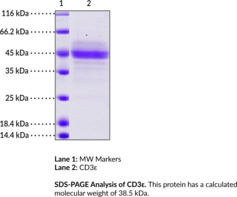
CD3 is a co-receptor for the T cell receptor (TCR), a cell surface receptor that recognizes antigens presented by MHC molecules and has a key role in the adaptive immune response.1,2 CD3 exists as a dimer composed of γ, δ, ε, or ζ subunits, which are type I transmembrane proteins encoded by distinct genes that enable TCR signal transduction.1,3 CD3ε is composed of an extracellular immunoglobulin (Ig) domain that mediates protein-protein interactions, a short membrane-proximal connecting peptide that is critical for TCR signaling, a transmembrane segment, and an intracellular immunoreceptor tyrosine-based activation motif (ITAM) that is phosphorylated by the tyrosine kinase Lck, resulting in T cell activation, proliferation, and survival.1,2,4 CD3ε forms heterodimers with CD3γ or CD3δ that interact with CD3ζζ homodimers to generate CD3 hexamers that noncovalently bind the TCR to form the CD3-TCR complex. Formulations containing murine anti-CD3ε IgG2a monoclonal antibodies have been used in the treatment of acute allograft rejection. Cayman's CD3ε (human, recombinant) can be used for binding assay and Western blot (WB) applications. This protein is a disulfide-linked homodimer. The reduced monomer, composed of CD3ε (amino acids 23-126) fused to human IgG1 Fc at its C-terminus, consists of 342 amino acids, has a calculated molecular weight of 38.5 kDa, and a predicted N-terminus of Asp23 after signal peptide cleavage.
WARNING This product is not for human or veterinary use.
References & Product Citations
1. Structural basis of assembly of the human T cell receptor–CD3 complex. Nature 573(7775), 546-552 (2019).
2. Molecular architecture of the αβ T cell receptor–CD3 complex. Proc. Natl. Acad. Sci. USA 111(49), 17576-17581 (2014).
3. Assembly of the TCR/CD3 complex: CD3ɛ/δ and CD3ɛ/ɣ dimers associate indistinctly with both TCR ɑ and TCR β chains. Evidence for a double TCR heterodimer model. Eur. J. Immunol. 28(1), 12-21 (1998).
4. Ionic CD3−Lck interaction regulates the initiation of T-
Contact Info
Cayman Chemical1180 East Ellsworth RoadAnn Arbor, Michigan 48108 USAToll Free: (800) 364-9897(USA and Canada only)Fax: (734) 971-3640


