
Technical Support & Resources
Information provided in the product description is from published literature. Due to the nature of scientific experimentation, your results (e.g., selectivity and effective concentrations) or specific application for this product may differ. If you have questions about how this product fits your application, please contact our technical support staff.
Visit our FAQ
Contact Us
Toll Free Phone (USA and Canada Only): (888) 526-5351
Direct Phone: (734) 975-3888

Technical Information
- p-Aminomethylbenzenesulfonamide
- 4-Homosulfanilamide
- Homosulfamine
- Marfanil
- Mesudin
Shipping & Storage Information
Recommended Products
Certificates of Analysis & Batch Specific Data
Provide batch numbers separated by commas to download or request available product inserts, QC sheets, certificates of analysis, data packs, and GC-MS data.
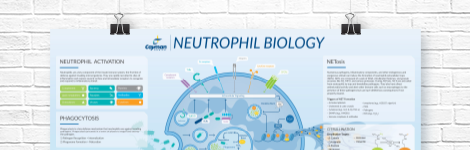
Neutrophil Biology Wall Poster
Explore how neutrophils shape the immune response in health and disease. This poster highlights neutrophil pathogen defense mechanisms, including phagocytosis, degranulation, and NETosis, as well as neutrophil roles in inflammation and NET-associated pathologies.
DOWNLOAD NOWProduct Description
Mafenide is a sulfonamide antibiotic.1,2 It is active against clinical isolates of S. pyogenes, methicillin-susceptible S. aureus (MSSA), methicillin-resistant S. aureus (MRSA), Enterococcus, Enterobacteriaceae, and Gram-negative bacilli from burn patients in an agar well diffusion assay (mean zone of inhibition = 24-37 mm) but not in a broth dilution assay with MIC values ranging from 250 to greater than 5,000 μg/ml.1 Mafenide is also active against clinical isolates of K. pneumoniae that produce extended spectrum β-lactamase (ESBL), P. aeruginosa, and A. baumannii-calcoaceticus from burn patients in an agar well diffusion assay (mean zones of inhibition = 23.5, 28.9, and 25.8 mm, respectively) but not in a broth dilution assay (mean MICs = 1,024 μg/ml for all).2 It decreases mortality in a rat model of burn wounds seeded with rat virulent P. aeruginosa.3 Mafenide also inhibits human carbonic anhydrase I (CAI) and CAII (Kis = 41.91 and 0.612 μM, respectively).4 Formulations containing mafenide have been used in the treatment of bacterial infections associated with burn wounds.
WARNING This product is not for human or veterinary use.
References & Product Citations
1. In vitro susceptibility testing of topical antimicrobial agents used in pediatric burn patients: Comparison of two methods. J. Burn Care Rehabil. 18(5), 406-410 (1997).
2. Activity of topical antimicrobial agents against multidrug-
3. Virulence of Pseudomonas infection in burned rats and mice. Comparative efficacy of silver sulfadiazine and mafenide. Arch. Surg. 101(4), 508-512 (1970).
4. Carbonic anhydrase inhibitors: Design, synthesis, kinetic, docking and molecular dynamics analysis of novel glycine and phenylalanine sulfonamide derivatives. Bioorg. Med. Chem. 23(23), 7353-7358 (2015).
Contact Info
Cayman Chemical1180 East Ellsworth RoadAnn Arbor, Michigan 48108 USAToll Free: (800) 364-9897(USA and Canada only)Fax: (734) 971-3640


