
Technical Support & Resources
Visit our FAQ
Contact Us
Toll Free Phone (USA and Canada Only): (888) 526-5351
Direct Phone: (734) 975-3888
Product Categories
Product Type

Technical Information
- Chondroitin Sulfate Proteoglycan 2
- Chondroitin Sulfate Proteoglycan Core Protein 2
- CSPG2
- ERVR
- GHAP
- Glial Hyaluronate-binding Protein
- Large Fibroblast Proteoglycan
- PG-M
- VCAN
- Versican Core Protein
- Versican Proteoglycan
- WGN
- WGN1
Shipping & Storage Information
Recommended Products
Certificates of Analysis & Batch Specific Data
Provide batch numbers separated by commas to download or request available product inserts, QC sheets, certificates of analysis, data packs, and GC-MS data.

Visit Our Cancer Resource Center
Find Tools & Resources to Study the Hallmarks of Cancer
- Cancer cell signaling & regulation
- Cancer metabolism
- Tumor microenvironment
Product Description
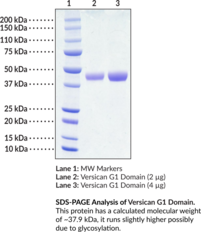
Versican is a secreted proteoglycan and member of the hyalectan family of proteoglycans.1,2 It is composed of an N-terminal G1 domain containing a secretory signal peptide, an immunoglobulin-like motif, and two proteoglycan tandem repeats followed by two glycosaminoglycan (GAG) binding regions, α-GAG and β-GAG, and a C-terminal G3 domain containing two EGF-like repeats, a carbohydrate recognition domain, and a complement-binding protein-like motif.2,3 Alternative splicing of versican produces four isoforms (V0-V3) that are expressed in a tissue- and development-specific manner and differ based on the GAG-binding region, containing either α- and β-GAG (V0), β-GAG only (V1), α-GAG only (V2), or no GAG-binding regions (V3).2 Versican is expressed in a variety of tissues, including connective tissue, cartilage, neural tissues, and vessels.4,5 It interacts with a variety of ligands, including hyaluronan at the G1 domain and fibulin-1 and -2 at the G3 domain.3 It is involved in tissue and organ development, including cardiac development, and is a structural macromolecule of the extracellular matrix (ECM) in various tissues in adulthood.3,5,6 Versican levels are increased in tumor tissue or peritumoral stromal cells in a wide range of cancers and are associated with poor outcomes.7 Mutations in VCAN, the gene encoding versican, are the cause of Wagner syndrome, a hereditary vitreoretinopathy characterized by early-onset syneresis and accelerated liquefaction of the vitreous.8 Cayman's Versican G1 Domain (human, recombinant) protein can be used for binding assay, ELISA, and Western blot (WB) applications.
WARNING This product is not for human or veterinary use.
References & Product Citations
1. Multiple domains of the large fibroblast proteoglycan, versican. EMBO J. 8(10), 2975-2981 (1989).
2. The interaction of versican with its binding partners. Cell Res. 15(7), 483-494 (2005).
3. V3: An enigmatic isoform of the proteoglycan versican. Am. J. Physiol. Cell Physiol. 325(2), C519-C537 (2023).
4. Distribution of the large aggregating proteoglycan versican in adult human tissues. J. Histochem. Cytochem. 44(4), 303-312 (1996).
5. Versican: A dynamic regulator of the extracellular matrix. J. Histochem. Cytochem. 68(11), 763-775 (2020).
6. Versican and versikine: The dynamism of the extracellular matrix. Proteoglycan Res. 1(4), e13 (2023).
7. The biological role and regulation of versican levels in cancer. Cancer Metastasis Rev. 28(1-2), 233-245 (2009).
8. Hereditary vitreoretinopathies: Molecular diagnosis, clinical presentation and management. Clin. Exp. Ophthalmol. 53(3), 281-291 (2025).
Contact Info
Cayman Chemical1180 East Ellsworth RoadAnn Arbor, Michigan 48108 USAToll Free: (800) 364-9897(USA and Canada only)Fax: (734) 971-3640


