
Technical Support & Resources
Information provided in the product description is from published literature. Due to the nature of scientific experimentation, your results (e.g., selectivity and effective concentrations) or specific application for this product may differ. If you have questions about how this product fits your application, please contact our technical support staff.
Visit our FAQ
Contact Us
Toll Free Phone (USA and Canada Only): (888) 526-5351
Direct Phone: (734) 975-3888
Product Categories
Technical Information
Shipping & Storage Information
Recommended Products
Certificates of Analysis & Batch Specific Data
Provide batch numbers separated by commas to download or request available product inserts, QC sheets, certificates of analysis, data packs, and GC-MS data.
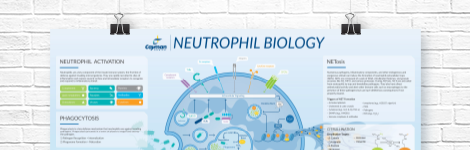
Neutrophil Biology Wall Poster
Explore how neutrophils shape the immune response in health and disease. This poster highlights neutrophil pathogen defense mechanisms, including phagocytosis, degranulation, and NETosis, as well as neutrophil roles in inflammation and NET-associated pathologies.
DOWNLOAD NOWProduct Description
Protonex™ Red 600 is a pH-dependent dye. It can be used in conjunction with additional dyes for multi-labeling purposes. Protonex™ Red 600 displays excitation/emission maxima of 576/597 nm, respectively, with high fluorescence intensity in acidic pH environments, such as phagosomes, endosomes, and lysosomes, but only weakly fluoresces in the extracellular environment. It can be used for fluorescence microscopy and flow cytometry applications. Protonex™ Red 600 has been used to measure intracellular acidity levels in isolated mouse bone marrow-derived macrophages (BMDMs).1
ASSAY PROTOCOL
Note: This protocol should be used as a guideline and modified according to the user's specific needs. Treat cells as desired prior to making the Protonex™ Red 600 working solution.
1. Prepare a 1-10 mM Protonex™ Red 600 stock solution in DMSO.
2. Treat cells as desired.
3. Prepare a 0.1-10 µM Protonex™ Red 600 working solution by diluting the DMSO stock solution into HEPES-buffered Hanks' balanced salt solution (HHBS) or a similar buffer.
4. Incubate the cells with Protonex™ Red 600 working solution for 15-120 minutes at 37°C.
5. Replace the dye-loaded solution with HHBS or a similar buffer.
6. Analyze the cells by fluorescence microscopy or flow cytometry.
WARNING This product is not for human or veterinary use.
References & Product Citations
1. The V-
Contact Info
Cayman Chemical1180 East Ellsworth RoadAnn Arbor, Michigan 48108 USAToll Free: (800) 364-9897(USA and Canada only)Fax: (734) 971-3640


