
Technical Support & Resources
Visit our FAQ
Contact Us
Toll Free Phone (USA and Canada Only): (888) 526-5351
Direct Phone: (734) 975-3888
Product Categories
Technical Information
- Apolipoprotein B
Shipping & Storage Information
Recommended Products
Certificates of Analysis & Batch Specific Data
Provide batch numbers separated by commas to download or request available product inserts, QC sheets, certificates of analysis, data packs, and GC-MS data.
Lipid Resource Center
Discover Products & Resources for Lipid Research
- High-purity lipid standards
- Lipid roles in biology
- Lipids in health & disease
- Lipids for pharmaceutical development
- Protocols, advice, & resources
Product Description
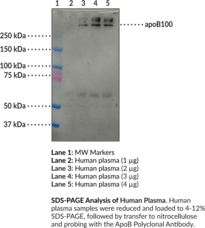
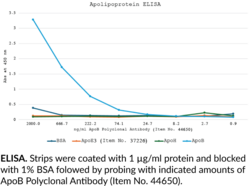
ApoB is an amphiphilic lipid carrier protein required as the structural component for atherogenic lipoproteins.1 It is expressed as two major forms: a truncated isoform, ApoB-48, which is expressed in the intestines, and full-length ApoB-100, which is expressed in the liver and to a lesser extent by cardiomyocytes.1,2,3 ApoB-100 is composed of βα1, β1, α2, β2, and α3 domains where the β domains are involved in forming irreversible bonds to the lipid core and the α domains have reversible lipid affinity.2 ApoB-48 is incorporated into chylomicrons and their remnants whereas ApoB-100 is incorporated into lipoproteins VLDLs, IDLs, and LDLs.1 Uptake of ApoB-containing lipoproteins is primarily mediated via the LDL receptor (LDLR), heparin sulfate proteoglycans, and scavenger receptor BI (SR-BI). Transgenic mice expressing human APOB and APOA fed an atherogenic diet exhibit increased levels of VLDL- and LDL-cholesterol and increased aortic lesion areas compared with non-transgenic mice.4 Mutations in APOB are associated with autosomal dominant hypercholesterolemia and familial hypobetalipoproteinemia.5,6 Cayman’s ApoB Polyclonal Antibody can be used for immunoprecipitation (IP) and Western blot (WB) applications.
WARNING This product is not for human or veterinary use.
References & Product Citations
1. Apolipoprotein B and cardiovascular disease: Biomarker and potential therapeutic target. Metabolites 11(10), 690 (2021).
2. Structure of apolipoprotein B-
3. Insights into apolipoprotein B biology from transgenic and gene-
4. Atherogenesis in transgenic mice with human apolipoprotein B and lipoprotein (a). J. Clin. Invest. 96(3), 1639-1649 (1995).
5. Molecular basis of autosomal dominant hypercholesterolemia: Assessment in a large cohort of hypercholesterolemic children. Circulation 123(11), 1167-1173 (2011).
6. A novel mutation of apolipoprotein B in a French Canadian family with homozygous hypobetalipoproteinemia. J. Clin. Lipidol. 5(5), 414-417 (2011).
Contact Info
Cayman Chemical1180 East Ellsworth RoadAnn Arbor, Michigan 48108 USAToll Free: (800) 364-9897(USA and Canada only)Fax: (734) 971-3640


