
Technical Support & Resources
Visit our FAQ
Contact Us
Toll Free Phone (USA and Canada Only): (888) 526-5351
Direct Phone: (734) 975-3888
Product Categories
Application
4-hydroxy Nonenal Monoclonal Antibody (HNEJ-1/Clone IG10) - HRP Conjugated
Item No. 45025
Technical Information
- 4-HNE
Shipping & Storage Information
Recommended Products
Certificates of Analysis & Batch Specific Data
Provide batch numbers separated by commas to download or request available product inserts, QC sheets, certificates of analysis, data packs, and GC-MS data.
Product Description
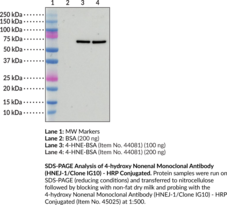
4-hydroxy Nonenal (4-HNE) is a lipid peroxidation product that reacts with lysine, cysteine, or histidine residues in proteins.1 It is found in all tissues and serum, and the formation of 4-HNE-modified proteins is associated with oxidative stress. 4-HNE can ligate to and inactivate cytosolic and mitochondrial proteins, leading to mitochondrial dysfunction, loss of cell proliferation and differentiation, increased intracellular calcium levels and production of pro-inflammatory cytokines, and apoptosis. 4-HNE levels are negatively regulated by aldehyde dehydrogenases (ALDHs), glutathione S-transferases (GSTs), and aldo-keto reductases (AKRs). Increased levels of 4-HNE protein adducts are found at the cell membrane, in the mitochondria, and in the cytosol during ferroptosis in vitro.2 4-HNE reduces mitochondrial oxygen consumption and membrane potential, as well as increases intracellular levels of reactive oxygen species (ROS), in vitro.3 4-HNE protein adducts increase in an age-related manner in the kidney, spleen, ovary, and uterus, but not the liver, in rats.2 4-HNE protein adducts are increased and GST levels are decreased in the brain of older mice in a Tg2576 mouse model of Alzheimer's disease, and increased levels of 4-HNE-modified proteins, including manganese superoxide dismutase (Mn-SOD), α-enolase, and malate dehydrogenase, are found in the inferior parietal lobule in postmortem brain from patients with early Alzheimer's disease.4,5 HNEJ-1 has high affinity for 4-HNE modifications at lysine, cysteine, or histidine residues, whereas HNEJ-2-5 have varying affinities for lysine and cysteine adducts.6 Cayman’s 4-hydroxy Nonenal Monoclonal Antibody (HNEJ-1/Clone IG10) - HRP Conjugated can be used for Western blot (WB) applications.
WARNING This product is not for human or veterinary use.
References & Product Citations
1. 4-
2. Embryonal erythropoiesis and aging exploit ferroptosis. Redox Biol. 48, 102175 (2021).
3. 4-
4. Involvement of peroxisome proliferator-
5. Proteomic identification of HNE-
6. Susceptibility of actin to modification by 4-
Contact Info
Cayman Chemical1180 East Ellsworth RoadAnn Arbor, Michigan 48108 USAToll Free: (800) 364-9897(USA and Canada only)Fax: (734) 971-3640


