
Technical Support & Resources
Visit our FAQ
Contact Us
Toll Free Phone (USA and Canada Only): (888) 526-5351
Direct Phone: (734) 975-3888
Technical Information
- BTB and CNC Homolog 2
Shipping & Storage Information
Recommended Products
Certificates of Analysis & Batch Specific Data
Provide batch numbers separated by commas to download or request available product inserts, QC sheets, certificates of analysis, data packs, and GC-MS data.

Visit Our Cancer Resource Center
Find Tools & Resources to Study the Hallmarks of Cancer
- Cancer cell signaling & regulation
- Cancer metabolism
- Tumor microenvironment
Product Description
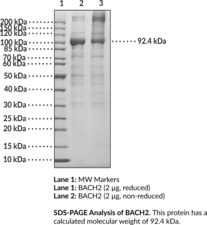
BTB and CNC homolog 2 (BACH2) is a transcription factor and member of the basic leucine zipper (bZIP) family.1 It is composed of a BTB domain, which participates in protein-protein interactions, an intrinsically disordered region, a bZIP domain, which mediates heterodimerization with small musculoaponeurotic fibrosarcoma (MAF) proteins, and a cytoplasmic localization signal and contains several heme binding sites. BACH2 is expressed in thymus, spleen, leukocytes, T lymphoid cells, and B- cells.2 It functions as a transcriptional repressor and is involved in B and T cell maturation and differentiation, immune homeostasis, and oxidative stress-induced apoptosis.1,2,3,4 Mutations in BACH2 are associated with immunodeficiency, colitis, and several autoimmune diseases, and increased intratumoral expression of BACH2 is associated with poor prognosis in patients with microsatellite instability-high (MSI-H) gastric cancer.5,6 Cayman’s BACH2 (human, recombinant) protein has a calculated molecular weight of 92.4 kDa.
WARNING This product is not for human or veterinary use.
References & Product Citations
1. Pathophysiological role of BACH transcription factors in digestive system diseases. Front. Physiol. 14, 1121353 (2023).
2. Cloning and expression of human B cell-
3. Repression of PML nuclear body-
4. Bcr-
5. BACH2 immunodeficiency illustrates an association between super-
6. Immune-
Contact Info
Cayman Chemical1180 East Ellsworth RoadAnn Arbor, Michigan 48108 USAToll Free: (800) 364-9897(USA and Canada only)Fax: (734) 971-3640


