
Technical Support & Resources
Visit our FAQ
Contact Us
Toll Free Phone (USA and Canada Only): (888) 526-5351
Direct Phone: (734) 975-3888
Technical Information
- ABTB3
- Ankyrin Repeat- and BTB/POZ Domain-containing Protein 3
- BTB/POZ Domain-containing Protein 11
Shipping & Storage Information
Recommended Products
Certificates of Analysis & Batch Specific Data
Provide batch numbers separated by commas to download or request available product inserts, QC sheets, certificates of analysis, data packs, and GC-MS data.

Visit Our Cancer Resource Center
Find Tools & Resources to Study the Hallmarks of Cancer
- Cancer cell signaling & regulation
- Cancer metabolism
- Tumor microenvironment
Product Description
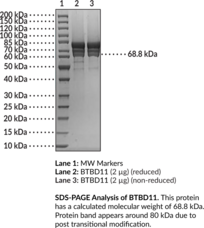
BTB/POZ domain-containing protein 11 (BTBD11) is a BTB-domain containing protein.1 It is composed of a disordered region, five ankyrin repeats, a BTB domain, and a PDZ-binding motif (PBM). Btbd11 is expressed in cortical and hippocampal inhibitory interneurons. It binds to postsynaptic density protein 95 (Psd-95) and is involved in regulation of glutamatergic synapses and neuronal circuit function. Knockout of the gene encoding Btbd11, Abtb3, in inhibitory neurons expressing the vesicular inhibitory amino acid transporter (VIAAT), also known as VGAT, increases rearing events in mice and decreases anxiety-like behavior in male mice. A SNP in ABTB3 is associated with risk of human papillomavirus-negative (HPV-negative) oropharyngeal cancer.2 Cayman’s BTBD11 (human, recombinant) protein has a calculated molecular weight of 68.8 kDa.
WARNING This product is not for human or veterinary use.
References & Product Citations
1. Btbd11 supports cell-
2. Germline determinants of humoral immune response to HPV-
Contact Info
Cayman Chemical1180 East Ellsworth RoadAnn Arbor, Michigan 48108 USAToll Free: (800) 364-9897(USA and Canada only)Fax: (734) 971-3640


