
Technical Support & Resources
Visit our FAQ
Contact Us
Toll Free Phone (USA and Canada Only): (888) 526-5351
Direct Phone: (734) 975-3888
Technical Information
- Cereblonmidi
Shipping & Storage Information
Recommended Products
Certificates of Analysis & Batch Specific Data
Provide batch numbers separated by commas to download or request available product inserts, QC sheets, certificates of analysis, data packs, and GC-MS data.
Product Description
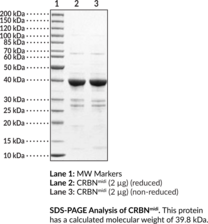
Cereblon (CRBN) is the substrate receptor component of the cullin 4 RING ligase (CRL4) complex.1,2 It is composed of an N-terminal unstructured region, a Lon protease-like domain, a helical bundle, and a thalidomide-binding domain.1,3 CRBN is ubiquitously expressed and localizes to the nucleus, cytoplasm, and plasma membrane.1 As part of the CRL4 complex with cullin 4, RING box protein 1 (RBX1), and DNA damage-binding protein 1 (DDB1), it facilitates the ubiquitination of substrates for proteasomal degradation. CRBN is involved in the regulation of ion channel expression, AMPK activation, energy metabolism, and endoplasmic reticulum (ER) stress.1,2,4 Mutations in CRBN are associated with autosomal recessive non-syndromic intellectual disability, and CRBN is also the target of thalidomide-induced teratogenicity.1,2,5 CRBN-targeting ligands, including thalidomide, pomalidomide, and lenalidomide, have been widely used to induce protein degradation using proteolysis-targeting chimera (PROTAC) technology.6 CRBNmidi is an engineered construct that contains the Lon protease-like domain, a Gly-Ser-Gly linker, part of the helical bundle, and the thalidomide-binding domain with C78I, I92V, K116N, Q134E, R283W, C287N, V293S, G302D, L342R, C343E, T359I, and L423I stabilizing mutations.3 These modifications enable the expression and purification of CRBN without co-expression of DDB1 in E. coli and the formation of binary and ternary complexes with degraders using crystallography. Cayman’s CRBNmidi (human, recombinant) protein has a calculated molecular weight of 39.8 kDa.
WARNING This product is not for human or veterinary use.
References & Product Citations
1. Cereblon in health and disease. Pflugers Arch. 468(8), 1299-1309 (2016).
2. Cereblon: Promise and challenges for combating human diseases. Pflugers Arch. 473(11), 1695-1711 (2021).
3. Design of a Cereblon construct for crystallographic and biophysical studies of protein degraders. Nat. Commun. 15(1), 8885 (2024).
4. Cereblon contributes to cardiac dysfunction by degrading Cav1.2α. Eur. Heart J. 43(20), 1973-1989 (2022).
5. Identification of a primary target of thalidomide teratogenicity. Science 327(5971), 1345-1350 (2010).
6. Induced protein degradation: An emerging drug discovery paradigm. Nat. Rev. Drug Discov. 16, 101-114 (2017).
Contact Info
Cayman Chemical1180 East Ellsworth RoadAnn Arbor, Michigan 48108 USAToll Free: (800) 364-9897(USA and Canada only)Fax: (734) 971-3640


