
Technical Support & Resources
Visit our FAQ
Contact Us
Toll Free Phone (USA and Canada Only): (888) 526-5351
Direct Phone: (734) 975-3888
Product Categories
Product Type
Technical Information
- B Cell Receptor CD22
- B-lymphocyte Cell Adhesion Molecule
- BL-CAM
- Sialic Acid-binding Ig-like Lectin 2
- Siglec-2
- T Cell Surface Antigen Leu-14
Shipping & Storage Information
Recommended Products
Certificates of Analysis & Batch Specific Data
Provide batch numbers separated by commas to download or request available product inserts, QC sheets, certificates of analysis, data packs, and GC-MS data.

Visit Our Cancer Resource Center
Find Tools & Resources to Study the Hallmarks of Cancer
- Cancer cell signaling & regulation
- Cancer metabolism
- Tumor microenvironment
Product Description
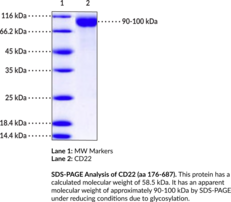
CD22 is a transmembrane receptor and member of the sialic acid-binding immunoglobulin-type (Ig-type) lectin (SIGLEC) family.1,2 It is composed of N-terminal extracellular Ig-like variable (IgV) and Ig-like constant 2 (IgC2) domains, a membrane-spanning region, and an intracellular immunoreceptor tyrosine-based inhibitory motif (ITIM) domain. CD22 has two isoforms formed via alternative splicing, CD22β, which is the full-length form and contains six IgC2 domains, and CD22α, which lacks the third and fourth IgC2 domains. It is expressed in the cytosol of premature B cells and on the cell surface of resting and activated B lymphocytes but is not expressed in differentiated B cells.3 CD22 is an inhibitory receptor activated by binding of α2,6-linked sialic acid-containing molecules, such as glycoproteins, which stimulates phosphorylation of tyrosine in the ITIM domain, leading to recruitment of Src homology 2 domain-containing phosphatases (SHPs), including SHP-1, spleen tyrosine kinase (Syk), LYN, and PI3K.1,2 Knockout of Cd22 decreases IgG1 titers in mice immunized with OVA/alum, and expression of human CD22 in Cd22 -/- mice rescues this phenotype.4 CD22 is overexpressed in cancer cells isolated from patients with hairy cell leukemia.3 Cayman's CD22 (aa 176-687) (human, recombinant) protein can be used for binding assay applications. This protein consists of 523 amino acids, has a calculated molecular weight of 58.5 kDa, and a predicted N-terminus of Trp176. By SDS-PAGE, under reducing conditions, the apparent molecular mass of the protein is 90-100 kDa due to glycosylation.
WARNING This product is not for human or veterinary use.
References & Product Citations
1. CD22: A regulator of innate and adaptive B cell responses and autoimmunity. Front. Immunol. 9, 2235 (2018).
2. CD22, a B lymphocyte-
3. HD39 (B3), a B lineage-
4. Human CD22 inhibits murine B cell receptor activation in a human CD22 transgenic mouse model. J. Immunol. 199(9), 3116-3128 (2017).
Contact Info
Cayman Chemical1180 East Ellsworth RoadAnn Arbor, Michigan 48108 USAToll Free: (800) 364-9897(USA and Canada only)Fax: (734) 971-3640


