
Technical Support & Resources
Information provided in the product description is from published literature. Due to the nature of scientific experimentation, your results (e.g., selectivity and effective concentrations) or specific application for this product may differ. If you have questions about how this product fits your application, please contact our technical support staff.
Visit our FAQ
Contact Us
Toll Free Phone (USA and Canada Only): (888) 526-5351
Direct Phone: (734) 975-3888
Product Categories
Research Area
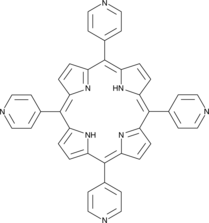
Technical Information
- 2HTPyP
- H2TPyP
- 5,10,15,20-Tetra(4-pyridyl)-21H,23H-porphine
- meso-Tetra(4-pyridyl)porphine
- Tetrakis(4-pyridyl)porphyrin
- T4PP
- 4-TPyP
- TPyP
Shipping & Storage Information
Recommended Products
Certificates of Analysis & Batch Specific Data
Provide batch numbers separated by commas to download or request available product inserts, QC sheets, certificates of analysis, data packs, and GC-MS data.

Visit Our Cancer Resource Center
Find Tools & Resources to Study the Hallmarks of Cancer
- Cancer cell signaling & regulation
- Cancer metabolism
- Tumor microenvironment
Product Description
5,10,15,20-Tetra(4-pyridyl)porphyrin is a synthetic building block that can form coordination complexes with transition metals.1 It displays an absorbance maximum at 417 nm that shifts upon complex formation with metal ions and has been used as a sensor for the detection of metal ions in water samples, aqueous solutions, and biological assays.2,3 Metal complexes synthesized from 5,10,15,20-tetra(4-pyridyl)porphyrin have been used as photosensitizers that reduce the viability of cancer cells in vitro.4 5,10,15,20-Tetra(4-pyridyl)porphyrin has been used to form metal-organic frameworks (MOFs) for the photocatalytic treatment of wastewater.5
WARNING This product is not for human or veterinary use.
References & Product Citations
1. Evolution of electronic and vibronic transitions in metal(II) meso-
2. Photothermal effects and fluorescence spectra of tetrapyridylporphyrins. J. Photochem. Photobiol. A Chem. 144, 93-99 (2001).
3. Recent advances in porphyrin-
4. Three palladium(II) meso-
5. Recent developments in porphyrin-
Contact Info
Cayman Chemical1180 East Ellsworth RoadAnn Arbor, Michigan 48108 USAToll Free: (800) 364-9897(USA and Canada only)Fax: (734) 971-3640


