
Technical Support & Resources
Information provided in the product description is from published literature. Due to the nature of scientific experimentation, your results (e.g., selectivity and effective concentrations) or specific application for this product may differ. If you have questions about how this product fits your application, please contact our technical support staff.
Visit our FAQ
Contact Us
Toll Free Phone (USA and Canada Only): (888) 526-5351
Direct Phone: (734) 975-3888
Product Categories
Technical Information
- JAU-6476
- PTCZ
Shipping & Storage Information
Recommended Products
Certificates of Analysis & Batch Specific Data
Provide batch numbers separated by commas to download or request available product inserts, QC sheets, certificates of analysis, data packs, and GC-MS data.
Lipid Resource Center
Discover Products & Resources for Lipid Research
- High-purity lipid standards
- Lipid roles in biology
- Lipids in health & disease
- Lipids for pharmaceutical development
- Protocols, advice, & resources
Product Description
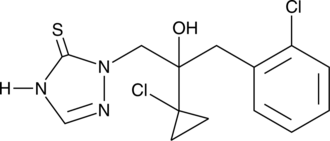
Prothioconazole (PTCZ) is a triazole fungicide.1 It is an inhibitor of the cytochrome P450 (CYP) isoform CYP51, also known as sterol 14α-demethylase. PTCZ (10 mg/kg of media) inhibits ergosterol biosynthesis and reduces deoxynivalenol biosynthesis in F. graminearum, the causative agent of Fusarium head blight, with a greater effect for (R)-PTCZ compared with (S)-PTCZ. It reduces mycelial growth of 252 strains of F. graminearum (EC50s = 0.4742-3.4403 µg/ml). PTCZ reduces the survival rate and induces malformations in zebrafish larvae at 0.35 µg/L, but does so to a lesser extent than (S)-(+)-PTCZ.2 It also reduces egg production in zebrafish. PTCZ (30 mg/kg per day) reduces hepatic glutathione (GSH) and superoxide dismutase (SOD) levels and increases hepatic TNF-α and IL-1β levels in mice.3 Formulations containing PTCZ have been used as fungicides in agriculture.
WARNING This product is not for human or veterinary use.
References & Product Citations
1. Stereoselective bioactivity of the chiral triazole fungicide prothioconazole and its metabolite. Pestic. Biochem. Physiol. 160, 112-118 (2019).
2. Stereoselective reproductive and intergenerational toxicity of prothioconazole in female zebrafish: Concurrent ovarian cytotoxicity and endocrine disruption. J. Agric. Food Chem. 74(29), 22708-22722 (2026).
3. Exposure to the fungicide prothioconazole and its metabolite prothioconazole-
Contact Info
Cayman Chemical1180 East Ellsworth RoadAnn Arbor, Michigan 48108 USAToll Free: (800) 364-9897(USA and Canada only)Fax: (734) 971-3640


